
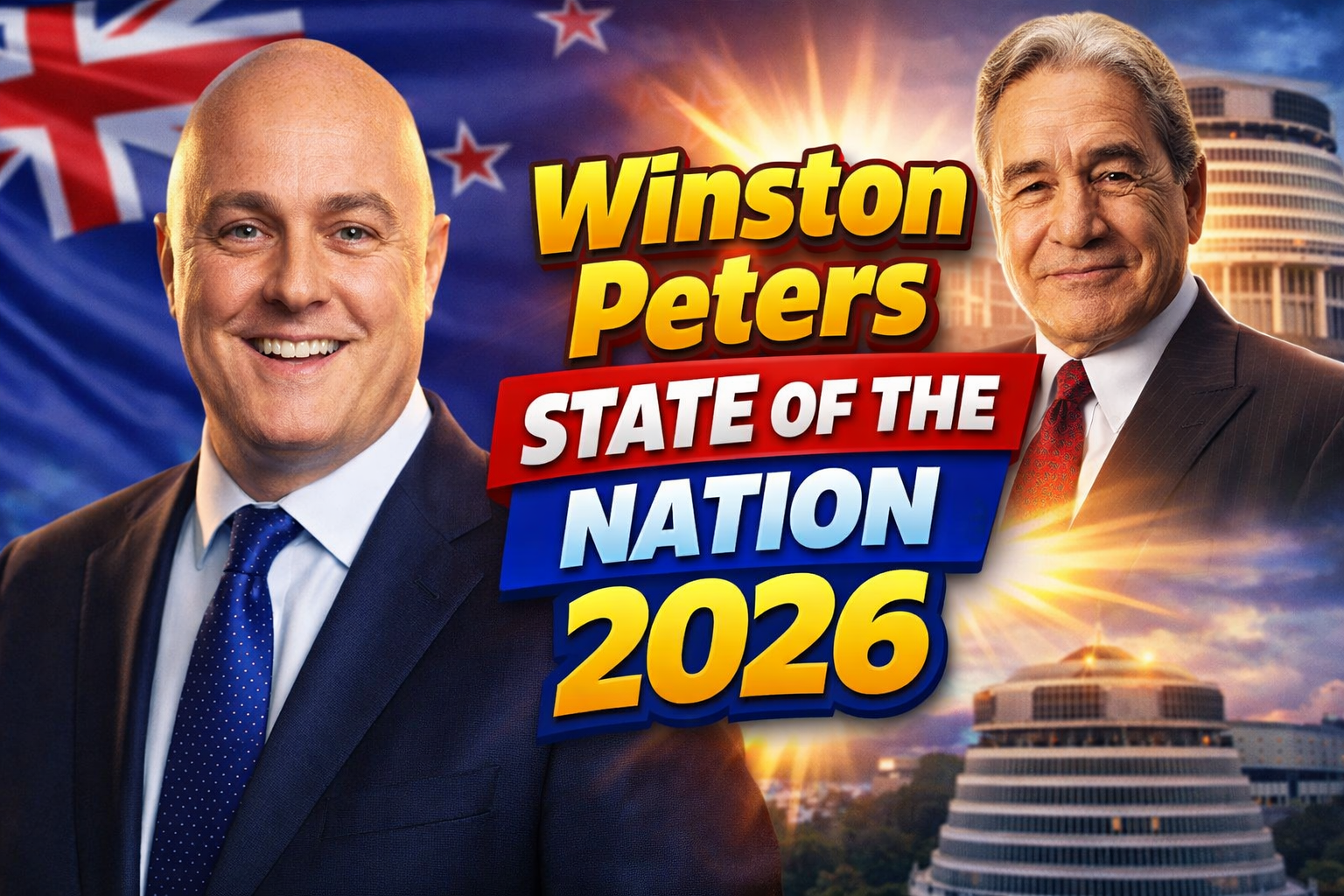
Winston Peters’ 2026 “State of the Nation” speech in Tauranga has effectively doubled as New Zealand First’s opening act in the 2026 general‑election campaign, laying out a populist, nationalist‑leaning platform that mixes economic grievance, culture‑war themes, and a strong push to re‑centralise power in the executive. Under the slogan “Power to the People,” Peters framed the country as being in a state of slow but steady decline, blamed decades of both Labour and National‑style economic management, and presented New Zealand First as the only party willing to impose tough, long‑term discipline while also rolling back policies he labels as “divisive” and “woke.” The speech and the party’s accompanying policy‑roll‑out sketch a campaign that is at once nostalgic, confrontational, and highly targeted at older, provincial, and economically‑anxious voters.
Tone And Narrative Of The 2026 Speech
Peters’ 2026 State of the Nation address is being widely read as a full‑spectrum nationalist pitch: part economic indictment, part cultural‑conservative manifesto, and part campaign‑launch keynote. He opened by placing New Zealand in what he described as the most challenging international environment in eighty years, arguing that the country now needs experience over ideology and pragmatism over “virtue signalling.” This framing is classic Peters: he positions himself and his party as the seasoned, un‑flashy operators who have weathered multiple crises, while implicitly casting rivals as short‑term, image‑driven politicians.
The overall message is that New Zealand is in deep trouble, that its problems are structural and long‑standing, and that quick fixes are not enough. Peters repeatedly insisted that New Zealand First had already been honest before the last election that the economic damage inherited from the Labour‑led government could not be “fixed in three years,” a line he used both to acknowledge present hardship and to distance his party from full ownership of the current situation. The underlying theme is that only a mature, tough‑minded party is prepared to make the hard choices that others avoid.
Economic Agenda: Austerity, Productivity, And “Power to the People”
At the heart of the 2026 platform is an economic‑recovery story that builds on the arguments Peters has been making since the party returned to coalition in 2023. He reiterated that New Zealand’s economy has been damaged by decades of what he calls neoliberalism, over‑borrowing, and what he describes as “consumption‑driven” rather than “production‑driven” policy. The Covid‑era borrowing of around sixty billion dollars became a central symbol in the speech, with Peters repeatedly questioning how much of that money was actually spent on the pandemic and how much vanished into other areas with little transparency.
The party’s 2026‑style economic platform, as outlined in the speech and related policy documents, focuses on:
- Fiscal discipline and long‑term repair, rather than quick‑fix gimmicks.
- Shifting support toward export‑oriented industries and regional‑economic development, echoing the export‑led‑growth language of earlier NZ First manifestos.
- Targeting cost‑of‑living burdens, including pressure on fuel prices, energy‑bills, and housing‑related taxes, while positioning the party as a defender of working‑class and small‑business interests.
The phrase “Power to the People” is used to frame this as a kind of economic‑sovereignty project: the idea that decisions that currently sit with distant governments, global markets, or “unelected experts” should be brought closer to voters and local communities. In practice, this translates into proposals for more ministerial control over certain projects, a more assertive stance on foreign‑investment and ownership, and a general push to restore state‑level discretion in areas where investors or agencies have gained influence.
Energy And Utility‑Focussed Policy
One of the most concrete new‑campaign‑platform items announced in the 2026 speech is a plan to split up the four major energy companies and use that restructuring to reduce power prices for households and small businesses. Peters argued that New Zealanders have long been “over‑charged” for electricity, and that the current structure of the energy sector limits competition and keeps prices higher than they need to be. By breaking up the large electricity‑generating and retail‑facing utilities and re‑shaping the market, NZ First wants to bring greater price transparency, enhance competition, and give consumers more leverage.
The speech also linked energy‑policy to broader economic‑sovereignty themes. Peters stressed that New Zealand should have more control over its own energy‑pricing and distribution, rather than being at the mercy of complex tariff structures and external‑market dynamics. This fits with the party’s long‑standing skepticism of what it sees as opaque, expert‑driven regulatory regimes, and it is likely to be a central talking point in the run‑up to the 2026 poll, especially in regions that feel particularly exposed to high power‑costs or energy‑security issues.
Regulatory Standards Act And Ministerial Powers
A key legislative‑target for NZ First’s 2026 election platform is the Regulatory Standards Act 2025. The party has already announced that it will seek to repeal this law if it returns to government, arguing that the Act tilts too far toward bureaucratic‑“red‑tape‑reduction” logic at the expense of environmental and social‑protection factors. The law, originally passed with NZ First’s support as part of the 2023–2026 coalition deal, has since become a lightning‑rod for criticism from parties on the left and from environmental groups, who see it as weakening safeguards.
Aligned with that stance, NZ First has also signalled it will campaign on reinstating ministerial powers to approve fast‑track projects, reversing elements of the 2025‑era reforms that aimed to depoliticise the fast‑track process. This is a deliberate move away from the idea of “independent‑expert‑driven” approvals and back toward a model where elected ministers can directly intervene in how major infrastructure and development projects are assessed and approved. For the party, this is a way of reclaiming political control over the investment and development agenda, and it is likely to be a major point of contrast with National‑style deregulation‑on‑steroids and Labour‑style environmental‑scrutiny‑heavy approaches.
Māori‑Related And Constitutional Policies
The 2026 State of the Nation speech also reinforced NZ First’s long‑standing ambivalence toward identity‑politics‑style Māori‑related policy. The party has confirmed that it will campaign for a referendum on the future of the Māori electorates, a long‑running item in the NZ First policy stable that periodically resurfaces ahead of elections. Peters has framed this as a question of national unity and equal‑citizenship, arguing that New Zealand should move toward a single‑electorate model where all voters compete for the same seats, regardless of ancestry.
The speech also emphasised the slogans “one people, one law, one flag,” a formula that has been a core part of Peters’ rhetoric for years. In 2026, he used it to criticise what he called “woke” and race‑obsessed politics in schools, universities, sports bodies, and government departments. The message is that New Zealand’s fundamental identity is being undermined by what he portrays as divisive, grievance‑oriented narratives tied to race and ethnicity, and that his party is the only one prepared to push back.
Culture‑War And “Anti‑Woke” Messaging
A central ideological pillar of the 2026 platform is Peters’ insistence on a “color‑blind state” and the rejection of “race‑based” or “identity‑driven” policy‑making. The speech hammered the idea that there is “one law for all”, and that New Zealand’s social cohesion is threatened by what Peters labels as a “woke” ideology that has spread through public‑service culture, education, and the media. He portrayed this as a kind of soft‑authoritarianism that punishes dissent, enforces political‑correctness, and sidelines ordinary citizens who do not subscribe to progressive‑social‑justice frameworks.
The culture‑war dimension of the speech is not just rhetorical; it ties into specific policy angles, such as:
- The proposed referendum on the Māori electorates, which is framed as a way of restoring “one‑person‑one‑vote” equality.
- A broader push for English to be promoted as New Zealand’s dominant formal language, with Peters questioning the role of Māori‑language‑driven policy in some areas.
- Criticism of “diversity‑and‑inclusion” initiatives that he claims privilege group identity over individual merit and shared national identity.
This language is designed to resonate with voters who feel culturally alienated by what they see as the dominance of progressive, urban‑led narratives, and it is likely to be a key mobilising theme in provincial and rural electorates.
International Relations And Immigration‑Linked Themes
While the 2026 speech is more domestically focused than some of Peters’ earlier foreign‑policy‑centred addresses, it still carries clear signals about how NZ First would handle international relations. The “dangerous world” frame is used to justify a more sovereigntist, and at times more transactional, approach to foreign policy. Peters stressed that New Zealand must be prepared to stand up for its own interests in the face of global instability, which he linked to the Middle East conflict, Indo‑Pacific‑related tensions, and broader great‑power competition.
The immigration‑linked rhetoric that has long been a feature of NZ First’s platform also remains. The 2026‑style messaging is framed less in the crude xenophobia of the 1990s and more in the language of “managed borders,” worker‑protection, and national‑security‑driven screening. The party continues to argue that migration‑policy has been too driven by employer‑demand and short‑term labour‑market needs, and that a more balanced, long‑term‑oriented approach is required.
Electoral Strategy And Targeting
New Zealand First’s 2026 election strategy, as signalled in the State of the Nation address and in the party’s public statements, is built on a few interlocking themes:
- Economic‑grievance‑plus‑stability: Peters’ emphasis on the long‑term nature of the country’s troubles is designed to inoculate the party against the “it’s been three years, why hasn’t everything improved?” critique, while also keeping the coalition‑partner‑role in play.
- Cultural‑conservative‑mobilisation: The “one‑people, one‑law, one‑flag” and “color‑blind state” messaging is aimed at consolidating support among older, white‑majority voters, particularly in regional towns and provincial centres.
- Niche‑policy‑planks: Issues such as the proposed energy‑company splits and the Māori‑electorate referendum give the party headline‑grabbing talking points that cut across both economic and cultural‑sovereignty narratives.
The party is also likely to lean heavily on Peters’ personal brand: the veteran politician who has seen multiple governments come and go, and who now portrays himself as almost the only figure with the credibility and experience to steady the ship in a turbulent world.
What This Means For The 2026 Election Landscape
In the broader context of the 2026 poll, Peters’ State of the Nation speech positions New Zealand First as a king‑maker‑style populist force that is unafraid to attack both major parties and that is willing to make bold, sometimes controversial, policy promises. The party is not leading the opinion‑polls, but it is clearly aiming to lock in a bloc of voters who feel economically squeezed, culturally alienated, and frustrated by what they see as short‑term‑ism and ideological polarization.
If the campaign gains traction, NZ First could once again sit in the middle of a fragmented parliament, holding the balance of power between a National‑led bloc and a Labour‑centred alternative. The 2026‑era platform—built on fiscal‑discipline, energy‑cost‑cutting, a referendum on Māori electorates, and a strong “anti‑woke” narrative—is designed to ensure that whatever coalition forms, New Zealand First will be able to claim that it shaped the terms of the deal around economic‑sovereignty, national‑identity, and reduced corporate‑power in key sectors such as energy.

Vineeth T.C. is a news writer and digital content contributor at PageEuropean, covering key developments across New Zealand and Australia. His work focuses on delivering clear, fact-based reporting on current affairs, public policy, business updates, and regional news that matter to readers.