
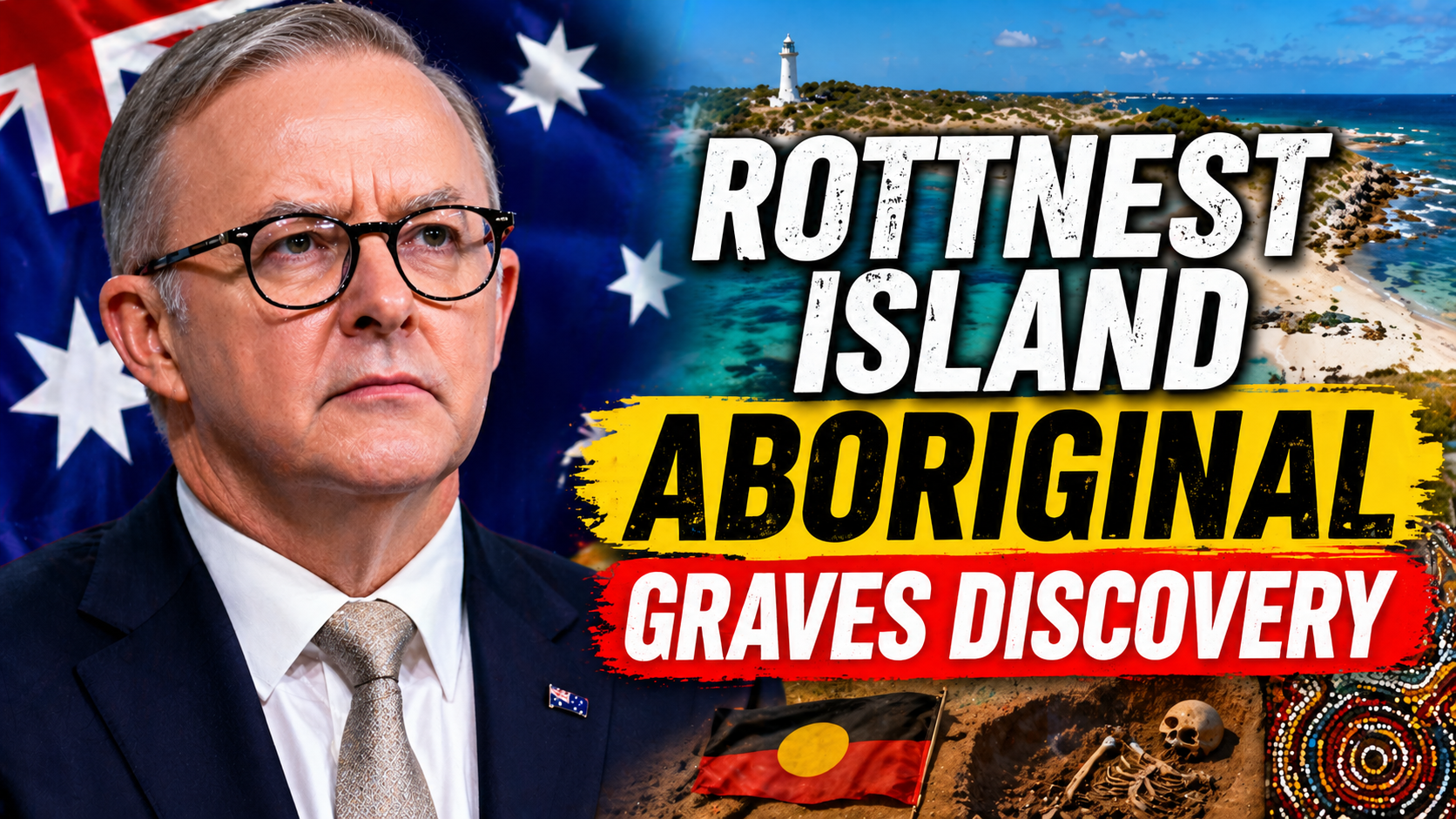
The recent discovery of Aboriginal graves on Rottnest Island—known to the Whadjuk Noongar people as Wadjemup—has reignited a painful, long‑held history while shining a spotlight on why Whadjuk cultural protocols are crucial to how the island is managed today. In April 2026, the uncovering of ancestral remains at a construction site near Holy Trinity Church temporarily halted major infrastructure work and forced authorities to confront the fact that the island’s surface still holds the traces of its colonial‑era Aboriginal prison past. For many Aboriginal families, the discovery was not just a historical footnote; it was a powerful reminder that the land is still a sacred resting place for ancestors, and that every decision on Wadjemup must be made in partnership with the Whadjuk people.
What has been found on Wadjemup
The remains were unearthed during excavation work for a new bus stop adjacent to the Holy Trinity Catholic Church, part of a broader upgrade project overseen by the Rottnest Island Authority. After the discovery, work stopped immediately and an on‑site archaeologist, along with independent cultural and forensic experts, was called in. Western Australian police and the state anthropologist later confirmed that the bones were of historical origin and consistent with Aboriginal ancestry, triggering automatic protections under the Aboriginal Heritage Act.
Soon after the initial find, further assessment using ground‑penetrating radar identified a cluster of additional potential burial sites nearby, pushing the total number of suspected graves into the double digits. The pattern and positioning of the remains were quickly recognised by senior Whadjuk cultural authorities as consistent with traditional Aboriginal burial practices, underscoring that the area is not just any parcel of land, but a graveyard and cultural‑heritage site of deep significance.
The discovery has halted or paused several construction and engineering works on the island, with authorities now coordinating with the Whadjuk Aboriginal Corporation and other Aboriginal groups to determine how to proceed. The immediate focus is on protection, documentation, and respectful consultation, rather than simply “moving on” with the original plans.
Why Wadjemup is a sacred and painful site
For the Whadjuk Noongar people, Wadjemup has layers of meaning that reach far beyond the sunburnt holiday‑island image many Australians recognise. Before sea levels rose thousands of years ago, the island was once part of the mainland; early Noongar lore associates it with important ceremonial and cultural activities. However, after European settlement, Wadjemup was transformed into a notorious Aboriginal prison, where men and boys from across Western Australia were held in harsh conditions from the mid‑19th to early 20th centuries.
The island’s former prison complex, known as the Quod, and the nearby Aboriginal burial ground became sites of immense suffering and loss. Oral histories and colonial records both describe overcrowding, disease, and high mortality rates, with many Aboriginal men buried in unmarked or poorly recorded graves. The recent discovery of ancestral remains near the churchyard is a physical echo of that grim history, confirming what many Aboriginal families had long believed: that the island’s soil contains the bones of their forebears.
Today, Wadjemup is both a major tourist destination and a place of mourning and remembrance for Aboriginal people. The contrast between the two perspectives—beaches and bicycles versus prisons and unmarked graves—lies at the heart of the ongoing reconciliation challenge.
Whadjuk cultural protocols on Wadjemup
Whadjuk cultural protocols are the practices, beliefs, and agreed‑upon rules that guide how the Whadjuk people interact with country, with one another, and with non‑Aboriginal visitors and authorities. On Wadjemup, these protocols are especially important because the land is not only a living landscape, but also a resting place for ancestors and the location of significant historical events that cannot be treated as neutral “development space.”
One of the core protocols is that any ground disturbance or construction work on the island must be preceded by Aboriginal‑led cultural‑heritage checks. That is why the project team had a Noongar cultural heritage monitor present during the excavation. When the remains were found, the monitor’s first step was not to continue digging, but to secure the site and escalate the matter to elders and to the Rottnest Island Authority, in line with the understanding that disturbing ancestral graves without proper process is deeply disrespectful.
Another key protocol is consultation before decision‑making. Whadjuk cultural authorities insist that they must be involved in determining how sites are treated once remains or cultural features are identified. This includes decisions about whether to re‑inter remains, whether to memorialise the area, and how future development can proceed without further disturbance. The Whadjuk‑led Wadjemup Project, a state‑funded initiative, is built around this principle: that any changes to the island’s layout, buildings, or commemorative infrastructure must be co‑designed with Whadjuk families and elders.
There is also a strong emphasis on spiritual awareness. Visitors are encouraged to understand that Wadjemup is not just a “holiday park” but a spiritual place where ancestors are still present. A traditional Whadjuk ritual observed by some visitors involves standing by the water’s edge, holding a small handful of sand, explaining why they have come to the island, and then releasing the sand into the water. This gesture is intended to show respect to the land and to the spirits of the ancestors, and to signal that the visitor acknowledges the Whadjuk people as the traditional custodians.
How the graves discovery is changing island management
The 2026 discovery has already reshaped how Rottnest Island is being managed. The Rottnest Island Authority has implemented tighter restrictions around the church and bus‑stop precinct, including fenced‑off areas and altered visitor pathways to prevent inadvertent disturbance of the burial zone. The authority has also committed to additional archaeological and geophysical surveys across the wider area before any further construction can resume.
More broadly, the find has accelerated the Wadjemup Project’s truth‑telling and memorialisation components. The project, which is Aboriginal‑led and state‑supported, aims to document the history of the Aboriginal prison and burial ground, design appropriate memorials, and conserve key structures such as the Quod. The Whadjuk Wadjemup Cultural Authority—elected by Whadjuk families—plays a central role in deciding what commemoration looks like, including whether gravestones, interpretive plaques, or ceremonial sites are appropriate.
For the tourism side of the island, there is a growing push to weave cultural‑heritage education into the visitor experience. The Rottnest Island Authority is considering producing short films and on‑ferry briefings that explain Wadjemup’s Aboriginal history, highlight the recent graves discovery, and underscore the importance of Whadjuk cultural protocols. The idea is that visitors arrive not only as holidaymakers, but as guests on Whadjuk country, with a responsibility to behave respectfully.
The broader significance for truth‑telling and reconciliation
The discovery of Aboriginal graves on Rottnest Island is part of a larger national conversation about truth‑telling and unmarked Aboriginal burial sites. Across Australia, colonial‑era prisons, mission stations, and institutions have left behind poorly documented graveyards, many of which were only acknowledged decades later. The fact that Aboriginal people on Wadjemup have known for generations that their ancestors lie in the ground—while the wider public treated the island largely as a recreational space—illustrates the gap between Indigenous memory and mainstream history.
The 2026 episode forces all Australians to ask what it means to truly acknowledge that history. It is not enough to simply install a memorial plaque; the deeper commitment is to change practices, protocols, and decision‑making structures so that Aboriginal voices are central whenever land that holds ancestral remains is planned or developed. That means designing development with the expectation that graves may be found, rather than treating such discoveries as inconvenient surprises.
For the Whadjuk people, this moment is both painful and potentially powerful. The re‑identification and protection of their ancestors’ resting places open the possibility of a more honest public narrative about the island’s past, and of a future where Wadjemup can be a place of healing, education, and respectful co‑existence rather than a site of buried trauma. The cultural protocols they hold, grounded in deep connection to country and respect for the dead, are now at the centre of that conversation—not as an afterthought, but as the guiding framework for how the island should be treated in the years ahead.

Vineeth T.C. is a news writer and digital content contributor at PageEuropean, covering key developments across New Zealand and Australia. His work focuses on delivering clear, fact-based reporting on current affairs, public policy, business updates, and regional news that matter to readers.