
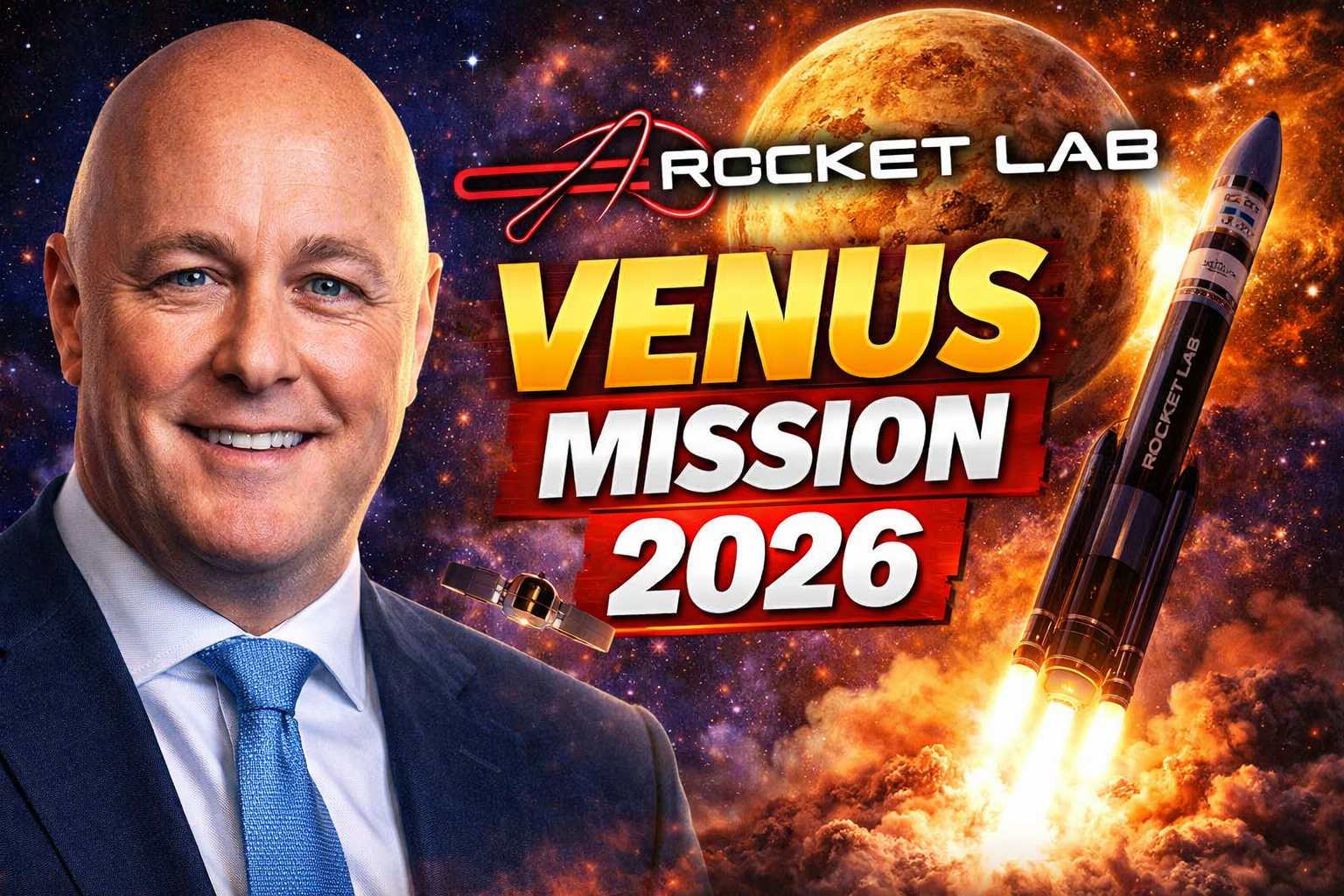
Rocket Lab’s Venus Life Finder mission stands as a pioneering private effort to probe Venus’s clouds for signs of life, with a targeted launch window opening in summer 2026. This compact probe, developed in partnership with MIT, represents a breakthrough in affordable deep-space exploration, leveraging Rocket Lab’s expertise in small satellite launches and interplanetary transfers.
Mission Background
The Venus Life Finder emerged from MIT professor Sara Seager’s vision to revisit phosphine detections in Venus’s atmosphere, a potential biosignature sparking global debate. Unlike NASA’s multi-billion-dollar DAVINCI or VERITAS probes, this private mission costs under 50 million dollars total, proving small teams can tackle big science.
Originally slated for 2023 on Rocket Lab’s Electron rocket, delays shifted timelines. A January 2025 window slipped due to integration challenges and funding refinements. Now NET summer 2026, the mission aligns with Rocket Lab’s Neutron debut, enabling heavier payloads and lunar gravity assists for efficient Venus trajectories.
Rocket Lab’s Photon spacecraft serves as the cruise vehicle, carrying the 20-kilogram cone-shaped probe. After launch from Māhia Peninsula, New Zealand, Photon performs burns culminating in a lunar swingby, reaching Venus in about 128 days.
Latest Launch Updates
As of March 2026, final integration nears completion at Rocket Lab’s Long Beach facility. The probe’s Autofluorescing Nephelometer (AFN)—a near-infrared spectrometer—underwent vacuum chamber tests, confirming fluorescence detection capabilities down to parts-per-billion organic molecules.
Peter Beck, Rocket Lab CEO, confirmed Neutron as the launcher during a February earnings call, citing Electron’s mass limits post-upgrades. Neutron’s first flight, scrubbed twice in early 2026 due to engine anomalies, now eyes April liftoff with the Venus mission riding its second flight.
Launch window spans June to August 2026, optimizing Earth-Venus geometry. Contingencies include a 2027 backup if Neutron certification lags. NASA granted a Category 3 launch license in January, streamlining approvals.
Mission control shifts to Auckland post-separation, with Auckland ground stations tracking descent. Data downlink peaks during the probe’s 3-5 minute cloud plunge from 60 to 45 kilometers altitude—the “habitable zone” shielded from surface hellfire.
Technical Innovations
The probe’s dome design withstands 90 atmospheres pressure and 470°C sulfuric acid clouds without active cooling. Passive survival relies on a diamond-windowed AFN scanning for organic glow under UV and IR lasers.
Photon’s upgrades include solar electric propulsion heritage from prior lunar missions, slashing delta-V needs. Lunar gravity assist shaves months versus direct hyperbolic transfers, conserving propellant.
Rocket Lab pioneered Photon as a “space tug,” evolving from kick stages. Venus Life Finder marks its first planetary science ride, following CAPSTONE’s lunar success.
| Component | Specs | Innovation |
|---|---|---|
| AFN Instrument | 1-5 μm NIR, 0.1 nm resolution | Organic fluorescence in acid clouds |
| Probe Mass | 20 kg | Hand-carryable, low-cost fab |
| Cruise Duration | 128 days | Lunar gravity assist |
| Descent Phase | 3-5 min, 60-45 km | No parachute, pure freefall data |
| Data Volume | 10 GB | Compressed burst transmission |
Private Space Exploration Breakthroughs
Rocket Lab redefines access: Electron boasts 50 launches by mid-2026, 95 percent success, deploying 1,800+ satellites. Neutron scales to 13-tonne LEO capacity, rivaling Falcon 9 at one-fifth cost.
Private Venus marks history’s first commercial planetary probe, bypassing government queues. MIT’s “garage project” ethos—weekends by grad students—democratizes astrobiology, echoing SpaceX’s reusability revolution.
Breakthroughs cascade: Reusable first stages (Electron recovery ongoing), 3D-printed Archimedes engines (Neutron), and in-orbit refueling demos planned post-Venus.
Science Goals and Payload
Primary: Detect amino acids, lipids via autofluorescence—signatures absent in abiotic chemistry. Secondary: Cloud particle sizing, refractive indices via polarimetry, validating phosphine contexts.
No radio occultation or radar; focus narrows for budget. Probe perishes post-descent, but Photon flies on for potential asteroid survey.
Cultural payload: Unreleased rap album “Out of This World” as a time capsule, blending art with science.
Rocket Lab’s 2026 Trajectory
Wallops Island’s Launch Complex 2 hit stride: March 5 Electron lofted BlackSky satellites, first 2026 success from Virginia. Mahia tempo accelerates to biweekly.
Neutron pad construction nears completion at Wallops; static fires imminent. Venus rides as anchor customer, validating medium-lift for NSSL Phase 3 bids.
Revenue triples year-over-year to 450 million dollars FY2025, space systems overtaking launches. Venus cements Rocket Lab’s interplanetary pivot.
Global Context and Competitors
NASA eyes VERITAS (2031), EnVision (2035). Private rivals: Impulse Space’s orbital tugs, Relativity’s Terran-R. China’s Tianwen-4 Venus sample return (2029) lags commercially.
Rocket Lab partners NASA JPL for Mars relay, ESA on lunar landers—Venus accelerates multiplanetary credibility.
| Mission | Operator | Launch | Cost | Goals |
|---|---|---|---|---|
| Venus Life Finder | Rocket Lab/MIT | 2026 | <50M | Life signs in clouds |
| DAVINCI | NASA | 2029 | 1B+ | Atmospheric entry |
| VERITAS | NASA | 2031 | 1.2B | Mapping orbiter |
| EnVision | ESA | 2035 | 700M | Surface radar |
| Shukrayaan-1 | ISRO | 2024* | 100M | Orbital science |
*Delayed.
Challenges Overcome
Delays stemmed from AFN fab hiccups—diamond coatings proved tricky—and Neutron engine iterations. Acid vapor corrosion tests iterated 20 designs; final titanium-composite shell passed 500-hour sims.
Funding: MIT seed plus Rocket Lab investment; no major grants. Beck: “We bet on ourselves.”
Regulatory: FAA/AST harmonization eased Neutron path; New Zealand’s lax regime aids Mahia.
Potential Discoveries and Impacts
Positive organics trigger follow-ons: larger probes, orbiters. Null result constrains Venus habitability models, refines exoplanet biosignatures.
Data public domain post-embargo, fueling PhD theses worldwide. Breakthrough reframes Venus from hellscape to testable analog.
Industry and Investor Buzz
Stock (RKLB) surged 15 percent post-Neutron scrub resolution. Analysts eye 10 billion valuation by 2030 on launch cadence.
Partnerships bloom: Viasat for comms, Blue Origin for engines. Venus headlines Q2 earnings.
Future Missions in Pipeline
Post-Venus: Mars helicopter relay (2028), Jupiter Trojans (2030 via Neutron fleet. Photon variants eye Europa clipper rideshares.
Neutron enables constellation megadeploys—1,000 Starlink-likes daily.
Broader Implications for Private Space
Venus Life Finder shatters NASA monopoly, slashing planetary barriers 90 percent. Proves PI-led science viable commercially.
Inspires: Student teams eye CubeSats; startups pitch astrobiology VCs. SpaceX Mars, Blue Moon landings get company.
Rocket Lab embodies Kiwi ingenuity scaling globally—Long Beach HQ, Virginia pads, New Zealand roots.
Legacy and Next Steps
Summer 2026 liftoff cements Rocket Lab interplanetary player. Probe’s plummet—humanity’s first private Venus dive—ignites imagination.
Beck: “Small probe, giant leap.” Success unlocks solar system for innovators, biosignatures or not.

Vineeth T.C. is a news writer and digital content contributor at PageEuropean, covering key developments across New Zealand and Australia. His work focuses on delivering clear, fact-based reporting on current affairs, public policy, business updates, and regional news that matter to readers.