
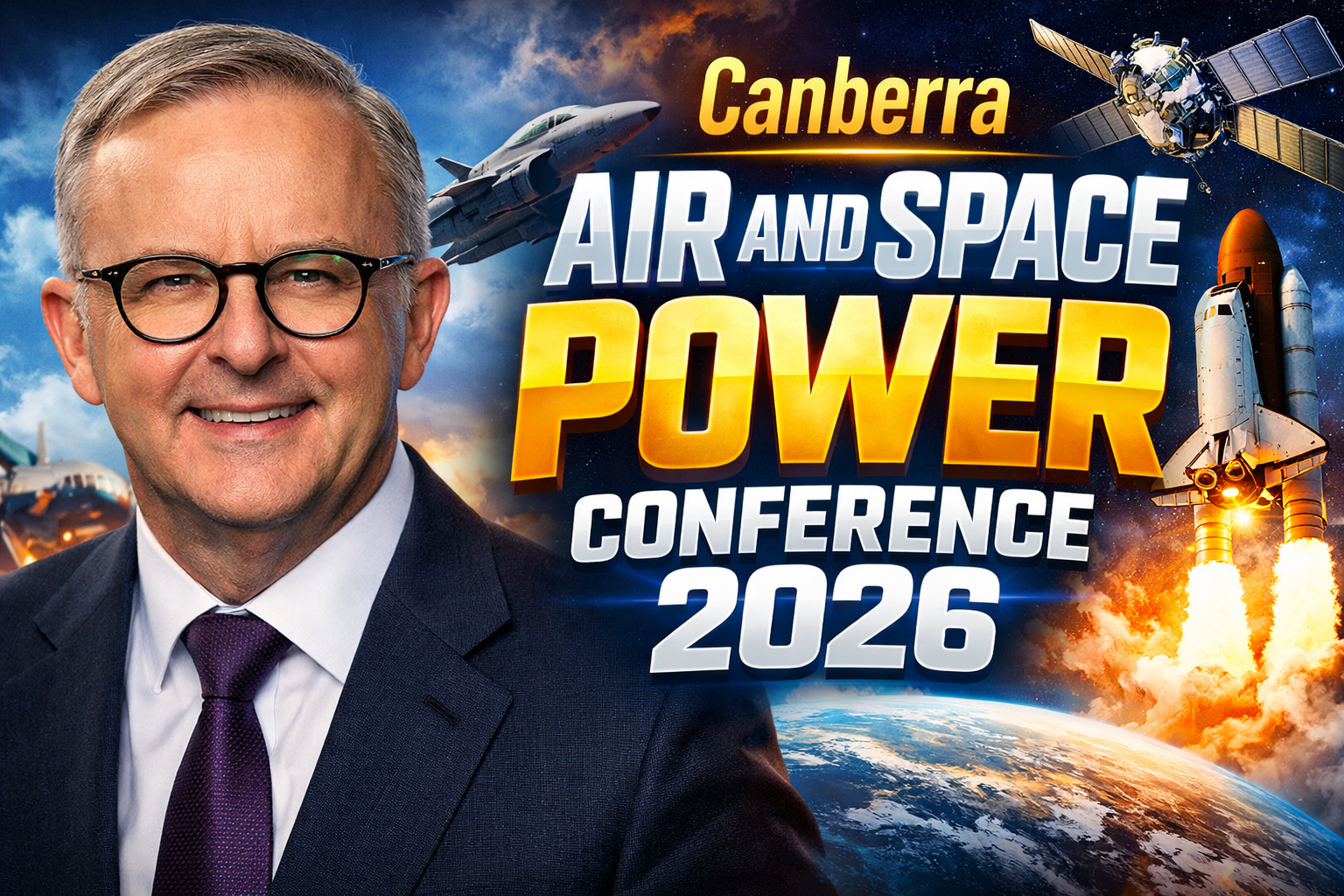
The Air and Space Power Conference 2026 unfolded today in Canberra, drawing top military leaders, policymakers, and experts to discuss air and space power’s pivotal role in national defense. Hosted by the Royal Australian Air Force’s Air and Space Power Centre at the National Convention Centre, the event emphasized building fighting depth amid rising Indo-Pacific tensions.
Conference Overview
ASPCon26 centered on the theme “Air and Space Power in National Defence,” addressing Australia’s strategic challenges shaped by geography, demographics, economics, and industry constraints. The one-day program featured keynote addresses, panel discussions, and networking, linking immediate priorities with future concepts.
Attendees included Pacific partners, international air chiefs, and domestic defense figures. Virtual access broadened reach, fostering global dialogue on integrated air and space capabilities. The conference highlighted the RAAF’s evolution within the Joint Capabilities Group.
Key Speakers and Sessions
Group Captain Jesse Laroche opened proceedings with an Acknowledgement of Country, setting a collaborative tone. Panels explored building fighting depth, with Air Vice-Marshal Steve Pesce, Deputy Chief of Air Force, leading discussions on operational readiness.
Air Vice-Marshal Glen Braz, Air Commander Australia, detailed force projection strategies. Air Vice-Marshal Nicholas Hogan, Head of Air Capability, covered acquisition and sustainment. Wing Commander Chris McInnes moderated, ensuring sharp exchanges.
Air Marshal Stephen Chappell, Chief of Air Force, delivered the closing address, reinforcing commitment to options in posture, space, and time.
| Session Time | Topic | Key Speakers |
|---|---|---|
| Morning | Conference Opening | Group Captain Jesse Laroche |
| Midday | Building Fighting Depth | AVM Pesce, AVM Braz, AVM Hogan |
| Afternoon | Strategic Environment | International Guests |
| Close | Final Remarks | Air Marshal Chappell |
Strategic Environment Addressed
Australia faces powerful, proximate threats demanding agile air and space forces. The conference stressed generating depth to provide governments flexible responses across domains. RAAF integrates with Army and Navy for multi-domain operations.
Discussions covered contested airspace, space domain awareness, and hypersonic threats. Emphasis fell on alliances like AUKUS Pillar II for advanced capabilities.
Boosting Defense Ties
Pacific representatives underscored the event’s value for regional cooperation. Attendees from partner nations highlighted shared security interests, joint exercises, and capacity building. Australia positions as a reliable partner, sharing airpower expertise.
Bilateral talks advanced interoperability, from F-35 integration to drone swarms. Conference side events facilitated MOUs and training pacts.
Regional Security Cooperation
Focus sharpened on Indo-Pacific stability amid China’s assertiveness and North Korean provocations. Panels advocated collective deterrence through information sharing and joint patrols.
Australia’s investments—loyal wingman drones, space surveillance—bolster collective defense. Cooperation extends to disaster response, leveraging airlift for humanitarian aid.
| Cooperation Area | Partners Involved | Outcomes Highlighted |
|---|---|---|
| Joint Exercises | Pacific Islands, US, Japan | Enhanced Interoperability |
| Space Awareness | Five Eyes, ASEAN | Threat Detection Networks |
| Training Programs | PNG, Fiji, NZ | Pilot and Tech Exchanges |
| Humanitarian Aid | Regional Forum | Rapid Response Frameworks |
RAAF Capability Developments
RAAF builds fighting depth via NGAD concepts, collaborative combat aircraft, and space resilience. Loyal Wingman program scales uncrewed systems for high-threat missions.
Air Commodore updates detailed MQ-28 Ghost Bat production ramp-up, targeting squadron strength by 2028. Space branch expansion includes satellite constellations for comms and ISR.
International Perspectives
Global air chiefs shared doctrines—USAF on Agile Combat Employment, RAF on Tempest integration. JASDF emphasized QUAD synergies; RAAFN on carrier ops.
Discussions aligned on countering A2/AD bubbles, electronic warfare dominance, and AI-driven command.
Technological Innovations Showcased
Emerging tech dominated—quantum sensors for navigation, directed energy weapons, hypersonic interceptors. Booths displayed Redback IFV air drops, HIMARS air transport.
AI for mission planning and swarm tactics featured prominently. Space traffic management tools addressed orbital congestion risks.
Policy and Budget Implications
Conference tied to 2026 Defense Strategic Review outcomes, advocating 3 percent GDP spend. Airpower investments—200 billion over decade—prioritize sustainment alongside acquisition.
Integration with AUKUS submarines, nuclear-powered subs enhances strike reach.
Pacific Engagement Spotlight
Pre-conference videos captured Pacific voices praising Australia’s leadership. Delegates from Fiji, PNG, Solomon Islands valued tech transfers and joint basing.
Pacific Step-Up evolves into airpower partnership, countering malign influence.
Challenges and Future Outlook
Panels candidly addressed recruitment shortfalls, supply chain vulnerabilities, and cyber threats to space assets. Solutions emphasized industry mobilization, STEM pipelines.
By 2030, RAAF envisions distributed lethality—forward bases, resilient C4ISR, uncrewed fleets.
| Challenge | Proposed Solutions |
|---|---|
| Workforce Gaps | Apprenticeships, Reserves |
| Supply Chains | Sovereign Production |
| Space Threats | Resilient Architectures |
| Budget Pressures | Prioritized Investments |
Media and Public Impact
Defence media covered live, with imagery pools released. Social media buzzed via #ASPCon26, amplifying messages to millions.
Event reinforces public support for airpower as freedom’s guarantor.
Broader Geopolitical Context
Conference occurs amid Taiwan Strait tensions, South China Sea maneuvers. Australia’s Ghost Bat exports signal tech diplomacy.
AUKUS expansion invites Japan, South Korea collaboration.
Legacy and Next Steps
ASPCon26 sets agenda for Airpower 2030 roadmap. Follow-up workshops refine concepts; Pacific air wings gain training slots.

Vineeth T.C. is a news writer and digital content contributor at PageEuropean, covering key developments across New Zealand and Australia. His work focuses on delivering clear, fact-based reporting on current affairs, public policy, business updates, and regional news that matter to readers.