
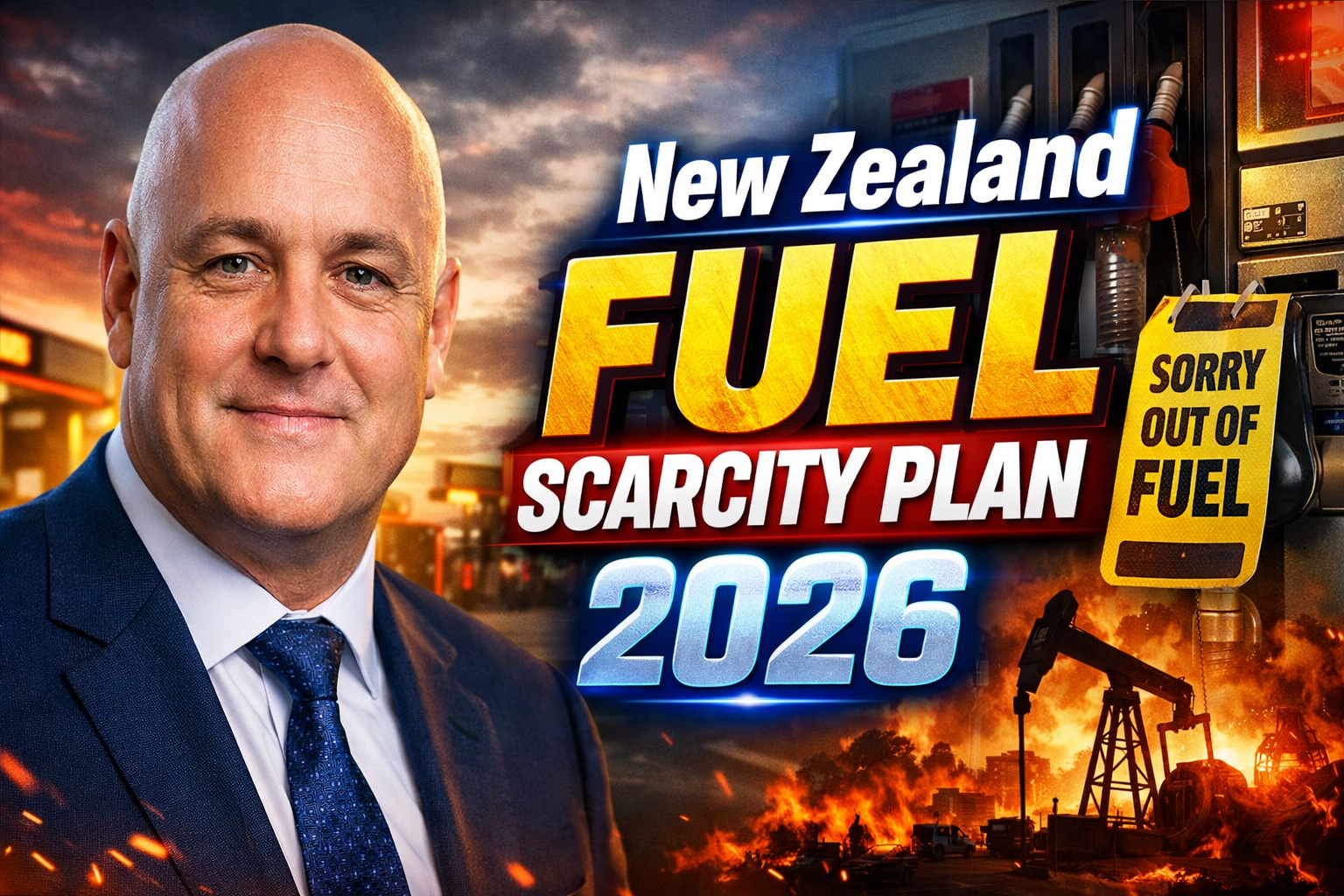
New Zealand is rolling out a major fuel‑security plan in 2026 as Finance Minister Nicola Willis delivers a high‑profile update on the country’s preparedness amid a surge in global fuel prices driven by the Middle East war. With petrol and diesel now costing well above three dollars per litre in many parts of the country, the government is trying to walk a tight line between reassuring the public, managing potential supply shocks, and keeping inflation and living‑cost pressures from spiraling out of control. The new Fuel Security Plan is designed to make New Zealand’s fuel system more resilient, but it also signals that authorities are no longer treating the global oil crisis as a distant problem—it is now a core part of the country’s economic‑security landscape.
How the Middle East War Is Hitting New Zealand
The ongoing conflict in the Middle East has sent shockwaves through global energy markets, with heavy fighting around key oil‑export routes and fears of a prolonged closure of the Strait of Hormuz. That has pushed benchmark oil prices sharply higher, and because New Zealand imports almost all of its refined fuel, those price spikes translate directly into pump increases. By mid‑March 2026, the national average price for 91‑octane petrol has climbed to around three dollars per litre, with diesel edging close to or even above three dollars in many regions.
For a small, import‑dependent economy like New Zealand, the impact goes beyond angry drivers at the bowser. Higher fuel costs ripple through transport, agriculture, manufacturing, and retail, feeding into broader inflation and squeezing household budgets that are already under pressure from rent, food, and utilities. The Ministry of Business, Innovation and Employment has warned that if the Middle East conflict drags on, the country could see slower growth, higher interest‑rate pressure, and a more prolonged period of elevated transport‑cost inflation.
The Core of New Zealand’s 2026 Fuel Security Plan
At the heart of the latest update is the government’s formalised Fuel Response Plan, a four‑tier framework that allows authorities to scale up their response from everyday monitoring through to extreme‑shortage measures. The plan is built around the idea that New Zealand can absorb a certain amount of disruption—such as delayed tanker shipments or rerouted cargoes—but only if it has clear communication, stock‑management rules, and contingency tools in place.
The top principle is that there will be no overnight jump to the highest alert level. Nicola Willis has publicly assured the country that ministers will not abruptly move up to a full‑blown emergency unless the risk of a prolonged supply shortfall becomes clear. Instead, the government is operating in a “pre‑alert” mode, with extra coordination between ministries, fuel‑importers, and civil‑defence agencies, while continuing to monitor shipments and stock levels on a twice‑weekly schedule.
Current Fuel Stocks and What They Mean
To reassure the public, the government has been releasing regular snapshots of fuel‑stock levels. As of mid‑March, New Zealand had about fifty‑two to fifty‑seven days of petrol supply and roughly forty‑seven to fifty days of diesel and jet fuel when stock both in the country and on the water are taken into account. These buffers are broadly consistent with historical averages, though officials emphasize that the situation remains fragile because the country depends on a steady flow of seaborne tankers.
Willis has acknowledged that keeping those buffers in place depends on continued tanker arrivals. Even a modest number of delayed or cancelled shipments, as seen in neighbouring Australia, could start to eat into the safety margin. The government is therefore using the current window to tighten stock‑holding expectations and to pressure the industry to avoid “just‑in‑time” ordering that leaves little room for disruption.
The Fuel‑Response Plan’s Tiers and Powers
The 2026 Fuel Response Plan is structured in tiers that mirror other national‑emergency frameworks. In the early stages, the focus is on monitoring, coordination, and public messaging. Authorities work with fuel‑importers to track shipments, confirm insurance coverage, and adjust commercial‑supply arrangements. They also issue guidance to the public about avoiding panic buying and hoarding, since those behaviours can quickly turn a modest supply‑chain hiccup into a visible shortage at the pump.
If the situation worsens, the plan allows for a range of demand‑management measures. These include voluntary appeals to conserve fuel, staggered service‑station opening hours, and targeted priority‑supply arrangements for essential‑service providers such as emergency‑services vehicles, healthcare‑transport fleets, and key freight operators. In a more severe scenario, the government could invoke older emergency‑powers legislation—sometimes referred to as “Muldoon‑era” rules—to introduce measures like carless days or temporary closures of certain service stations.
Worst‑Case Scenarios and Contingency Thinking
Finance Minister Nicola Willis has confirmed that the government is now actively considering worst‑case scenarios, including the possibility of a prolonged Middle East conflict that could keep oil prices high and tanker‑schedules erratic for months. In that context, the risk is not just higher prices but the potential for supply‑chain bottlenecks to create localized shortages, particularly in remote regions or at the end of long‑transport‑chains.
Officials have indicated that if the outlook beyond the fifty‑day stock buffer were deemed seriously threatened, more intrusive measures would be on the table. These could range from temporary fuel‑rationing schemes to more aggressive coordination of fuel‑distribution between regions. The government has tried to be transparent about the fact that such steps are still hypothetical, but it is also making clear that it would not hesitate to act if the fuel‑security situation deteriorated.
Price‑Surge Protections and Support Measures
Alongside the formal security plan, the government has announced a fuel‑assistance package aimed at cushioning the impact of high pump prices on households and small businesses. The exact design varies by region, but key elements include temporary fuel‑subsidy top‑ups, targeted payments for heavily fuel‑dependent industries such as long‑haul trucking and regional‑air services, and enhanced support for low‑income families who spend a disproportionate share of their income on transport.
Officials stress that these measures are intended to be fiscally disciplined, with clear sunset dates and safeguards to prevent the payments from feeding further inflation. The underlying message is that the government will not try to hold prices artificially low forever, but it is prepared to provide targeted relief during the most acute phase of the crisis.
Industry‑Level Changes and Stock‑Holding Rules
A longer‑term pillar of the 2026 Fuel Security Plan is reshaping how fuel importers hold stock. The government is moving toward a more prescriptive regime in which major fuel companies are required to maintain additional diesel reserves from 2028, with a review in 2026 to consider extending the requirement to all importers. Jet fuel is also being brought into the framework: from late 2026, importers must keep a ten‑day supply of jet fuel at 80 percent of normal capacity at Auckland Airport, effectively creating a buffer for the country’s busiest aviation hub.
These changes are being framed as a shift from a purely commercial‑risk approach—where companies decide how much stock to hold based on price and margins—to a more nationally strategic one. By hardwiring minimum stock levels into the regulatory framework, the government hopes to reduce the odds of a sudden, cascading shortfall if tanker‑schedules are disrupted by conflict, sanctions, or insurance‑market volatility.
Comparing New Zealand’s Approach to Australia and Other Allies
The 2026 plan places New Zealand in a similar position to other import‑dependent countries that are now treating fuel security as a national‑security matter. Australia, for example, has already toughened its own stock‑holding rules and is actively using its emergency‑powers levers to manage regional shortages. The UK and several European states have also updated their fuel‑contingency frameworks in recent years, reflecting the lingering lessons of past oil‑price shocks and the fragility of global supply chains.
New Zealand’s approach is distinctive in its emphasis on four‑stage escalation and its explicit linkage between fuel‑security planning and broader economic‑stability goals. Unlike some countries that focus narrowly on keeping the military and civil‑defence fleets running, New Zealand is explicitly tying fuel‑security to the continued functioning of the transport, freight, and regional‑air‑network systems that keep the country connected.
How the Public Is Being Prepared
Public‑communication is a central piece of the 2026 update. The government is using a mix of media briefings, digital dashboards, and localized outreach to explain stock levels, alert‑system tiers, and the kinds of measures that could be deployed if the situation worsens. The goal is to reduce speculation and panic buying by giving people a clearer picture of the baseline situation and the tools available to manage any disruption.
Willis has repeatedly urged New Zealanders to purchase only the fuel they realistically need, avoid hoarding, and consider carpooling, public transport, or off‑peak travel where possible. For businesses, the message is to plan ahead, review fuel‑contracts, and engage with fuel‑suppliers early if they operate in supply‑chain‑critical sectors such as healthcare, food distribution, and regional transport.
What This Means for the Future of New Zealand’s Energy Security
The 2026 Fuel Security Plan is not just a reaction to the Middle East war; it is a signal that New Zealand is adopting a more systematic approach to energy‑supply risk. Beyond the current price spike, the government is using this episode to revisit fuel‑import patterns, minimum‑stock standards, and the role of renewable energy and electrification in reducing long‑term dependence on liquid fuels.
There is also a growing recognition that future shocks may come not only from war but from climate‑related disruptions to shipping routes, extreme weather events, and cyber‑attacks on energy‑infrastructure. By embedding a structured fuel‑response framework now, policymakers are hoping to build a more flexible, transparent, and resilient system that can adapt to whatever comes next.
The Political and Economic Tightrope
For Nicola Willis and the coalition government, the fuel‑crisis agenda is a classic political tightrope. On one side is the need to project calm and competence, to avoid the impression that the country is drifting toward a chaotic shortage. On the other side is the reality that no amount of planning can fully insulate New Zealand from a global oil‑price shock, especially when the conflict is in a region that supplies a large share of the world’s crude.
The 2026 Fuel Security Plan is therefore both a practical contingency tool and a political statement: that the government is taking the risk seriously, that it has a clear playbook, and that it will not wait until the last tank is empty before acting. Whether that message is enough to keep public confidence during what could be a prolonged period of high fuel prices will depend not only on the plan itself, but on how clearly and consistently it is communicated as the Middle East situation continues to evolve.

Vineeth T.C. is a news writer and digital content contributor at PageEuropean, covering key developments across New Zealand and Australia. His work focuses on delivering clear, fact-based reporting on current affairs, public policy, business updates, and regional news that matter to readers.