
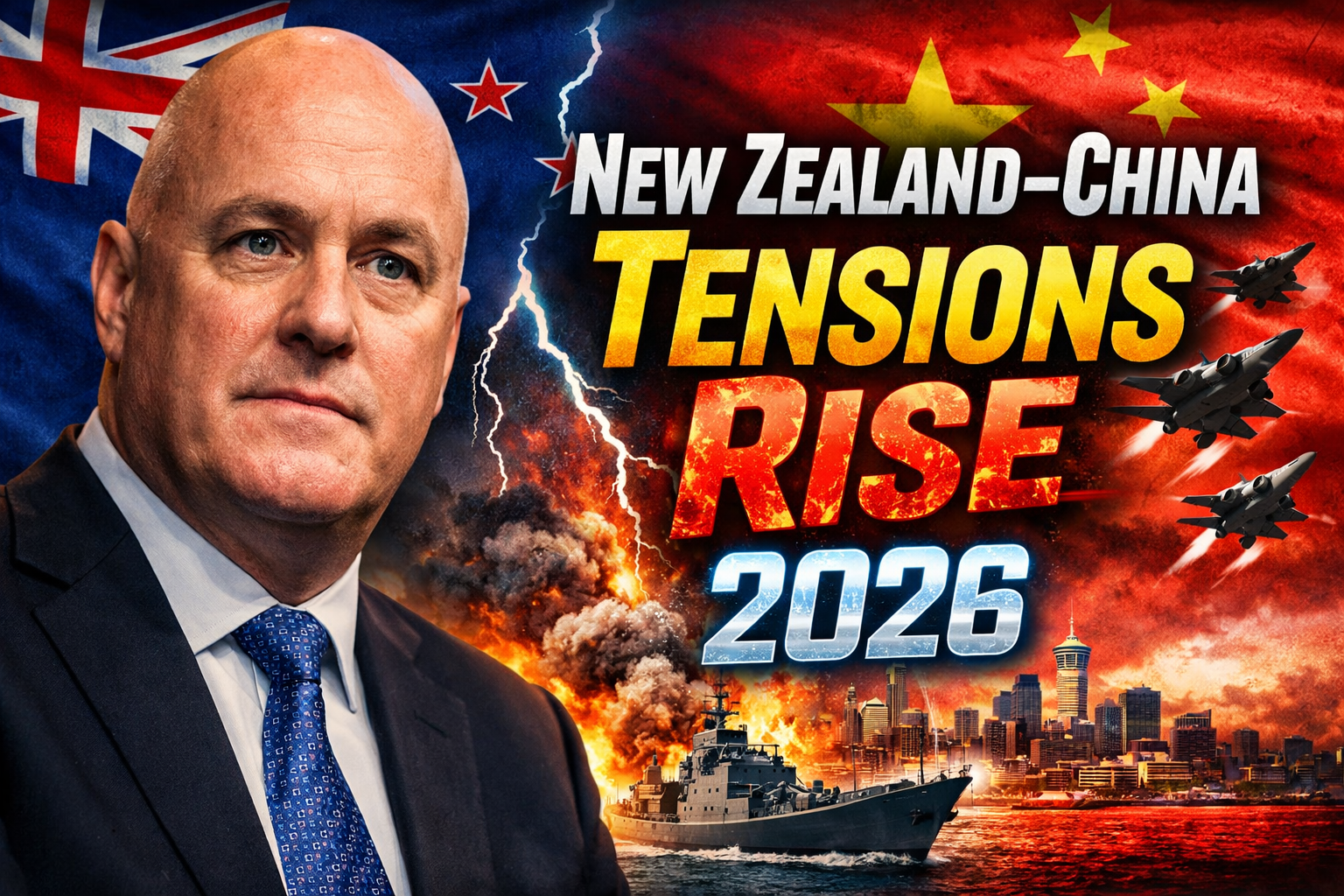
A routine maritime surveillance mission has suddenly become a flashpoint in the already tense relationship between New Zealand and China. In early April 2026, a Royal New Zealand Air Force P‑8A Poseidon maritime patrol aircraft conducted a long‑range patrol flight over the Yellow Sea and East China Sea, drawing sharp diplomatic protests from Beijing. The episode symbolizes how New Zealand, long known for its cautious, trade‑driven China policy, is now being drawn into the wider security and intelligence contest in the Indo‑Pacific. What began as a technical enforcement operation under UN sanctions has evolved into a test of how far Wellington is willing to go, and how hard Beijing will push back.
The P‑8A patrol that sparked the row
The Royal New Zealand Air Force operates a small fleet of Boeing P‑8A Poseidon aircraft, each a highly capable long‑range maritime patrol and reconnaissance platform based on the 737 airframe. The P‑8A is designed for anti‑submarine warfare, anti‑surface warfare, and intelligence, surveillance, and reconnaissance missions. It can carry torpedoes, Harpoon anti‑ship missiles, mines, and an array of sensors, allowing it to detect ships, submarines, and irregular maritime activity over vast stretches of ocean.
In this instance, the aircraft flew a mission that took it into the Yellow Sea and East China Sea, areas that China considers central to its national security and maritime sovereignty. Chinese officials have described the flight as “continuous close‑in reconnaissance and harassment” near their coastlines, claiming that the Poseidon operated in a manner that destabilized regional flight order and potentially endangered civilian air traffic. Beijing has framed the sortie as a deliberate intrusion designed to support broader Western security planning against China, rather than a neutral, law‑based enforcement action.
New Zealand’s official explanation
Wellington has pushed back hard against China’s characterization. The New Zealand Defence Force has issued a statement insisting that the P‑8A was operating lawfully and professionally, in accordance with international rules governing airspace and maritime zones. According to the NZDF, the flight was part of a broader effort to monitor and enforce UN Security Council sanctions on North Korea, specifically focusing on suspected sanctions‑evasion activities such as illicit ship‑to‑ship transfers and shadow‑fleet operations.
New Zealand is a member of multilateral maritime enforcement initiatives linked to those UN resolutions, and its P‑8As are routinely used to patrol maritime spaces of strategic interest. The government has argued that the aircraft did not violate any sovereign territory or deliberately provoke Beijing, and that its sensors and communications were used strictly within the bounds of international law. Officials in Wellington have also emphasized that the flight was part of a wider pattern of regional cooperation, not a unilateral move against China.
Nonetheless, the fact that the patrol took place so close to the Chinese mainland, in a body of water that China treats as a key buffer zone, has made the optics extremely difficult. For New Zealand, the mission fits within a self‑image of “responsible middle power” upholding multilateral rules. For Beijing, it looks like a small, distant ally amplifying the surveillance footprint of larger Western powers right on China’s doorstep.
Chinese reaction and diplomatic fallout
China’s response has been swift and pointed. The Ministry of Foreign Affairs has issued strong statements accusing New Zealand of undermining China’s sovereignty and security interests, and of “harassing” Chinese air and naval operations. Beijing has also suggested that the flight disrupted normal civil aviation patterns and increased the risk of miscalculation or mid‑air incidents. The language used by Chinese officials has been more strident than in many recent diplomatic exchanges, suggesting that Beijing is treating the incident as a deliberate signal rather than a one‑off operational misstep.
Behind the scenes, diplomatic channels have been busy. Chinese envoys in Wellington have reportedly raised the issue at senior levels, pressing New Zealand to clarify its intentions and signalling that repeated similar flights could see a tougher response. Although no formal sanctions or punitive measures have been announced yet, there is concern that Beijing could leverage its economic leverage—New Zealand’s heavy reliance on Chinese markets for dairy, meat, and other exports—as a tool of pressure in the future.
The Yellow Sea patrol has also fed into a broader narrative in Chinese state media that “third‑party” countries are being drawn into a US‑led containment strategy against China. Editorials have highlighted New Zealand’s recent defence and security moves, including its participation in regional military exercises and intelligence‑sharing arrangements, as evidence that even small Pacific states are being co‑opted into a Cold‑style alliance network. For Beijing, that makes any New Zealand military activity in China’s immediate maritime neighborhood especially sensitive.
How this fits into wider New Zealand–China relations
New Zealand–China relations in 2026 are characterized by a widening gap between economic interdependence and strategic divergence. On the trade side, China remains one of New Zealand’s largest export markets, underpinning livelihoods in agriculture, forestry, and tourism. At the same time, Wellington has been adjusting its security posture in response to growing concerns about China’s assertive behaviour in the Pacific, South China Sea, and broader Indo‑Pacific region.
In recent years, New Zealand has quietly strengthened its defence and intelligence ties with the United States, Australia, and like‑minded partners. It has invested in modern surveillance platforms such as the P‑8A Poseidon, expanded its participation in regional security forums, and reassessed how it balances close economic ties with Beijing against its commitments to open‑rules‑based order and alliance cooperation. The ANZUS‑adjacent security architecture, while not formally binding New Zealand to the same level of US‑style containment, has nonetheless nudged Wellington toward a more visible alignment with Western partners in the maritime and intelligence domains.
The Yellow Sea patrol sits squarely at that intersection. It is not a frontline combat mission, but it is a highly symbolic act of surveillance in a region that China sees as a core strategic space. For many analysts, the incident reflects a quiet shift in New Zealand’s posture: from a country that traditionally avoided direct involvement in major‑power security competition, to one that is increasingly willing to contribute its niche capabilities in support of broader international enforcement and deterrence goals.
Why the Yellow Sea matters in this dispute
The Yellow Sea is a semiclosed body of water between China and the Korean Peninsula, bordered by China, North Korea, and South Korea. Its strategic importance comes from several factors. It hosts major Chinese naval facilities, forms part of the coastal approach to Beijing and other key economic zones, and lies along crucial shipping lanes used for energy and trade. China also regards the Yellow Sea as a sensitive zone for submarine and surface‑fleet operations, making it particularly wary of foreign surveillance flights along its fringes.
By conducting a Poseidon patrol in this area, New Zealand has effectively placed its surveillance assets in a zone that China monitors closely and often treats with a high degree of suspicion. Maritime patrol aircraft like the P‑8A can track shipping patterns, detect unusual vessel behaviour, and gather signals and radar data that may be of intelligence value to allied navies. Even if the immediate mission objective is limited to sanctions enforcement, the broader context inevitably colours how such operations are interpreted.
For Beijing, the fact that a small Pacific nation is operating such a sophisticated platform in China’s maritime “near space” reinforces perceptions of encirclement and external pressure. For Wellington, the same flight can be framed as a contribution to a rules‑based system that all states, including China, are supposed to respect. The tension lies in the clash between these two narratives: one of sovereignty and strategic vulnerability, the other of impartial enforcement and multilateral responsibility.
Risks of escalation and prospects for cooling down
The immediate risk in this episode is miscalculation rather than open confrontation. A close‑in reconnaissance flight, even if legal under international law, can create friction if it is perceived as provocative or unnecessarily intrusive. There are also concerns that repeated such operations could increase the chances of dangerous air or maritime encounters, especially if Chinese fighter jets or naval vessels are scrambled to shadow or challenge foreign aircraft.
At the same time, both sides have strong incentives not to let this incident spiral. New Zealand has long sought to avoid framing its policy as anti‑China, instead emphasising that it is pro‑rules and pro‑stability. Beijing, for its part, is keen to signal resolve but also to avoid a costly public feud with a relatively small partner that is economically important to New Zealand’s primary industries. The diplomatic language, while tough, has so far stopped short of recalling ambassadors or imposing immediate sanctions, suggesting that both capitals are still testing the waters rather than committing to a more confrontational line.
In the coming weeks, the trajectory of the dispute will likely depend on several factors. Will New Zealand conduct similar long‑range patrols in the same area, or will it signal a degree of restraint while maintaining its right to participate in sanctions‑enforcement missions? Will China respond with further diplomatic protests, limited counter‑measures, or a mix of both? And how will other regional actors, including the United States, Australia, Japan, and South Korea, react to this small but symbolically charged friction?
What this means for the Indo‑Pacific security picture
Beyond the bilateral row, the New Zealand P‑8A incident reflects a broader trend in the Indo‑Pacific: the blurring line between economic cooperation and security competition. Middle and smaller powers are increasingly finding that they cannot completely separate their trade relationships from their security choices. Surveillance flights, port visits, and intelligence‑sharing agreements that once seemed purely technical now carry political weight, especially when they touch China’s maritime periphery.
For New Zealand, the Yellow Sea patrol is a reminder that even modest military contributions can have outsized diplomatic consequences. The P‑8A fleet is a small fraction of the global maritime‑surveillance capacity, but its use in this context signals that Wellington is willing to contribute to a Western‑led security framework in ways that Beijing finds uncomfortable. At the same time, the incident underscores the limits of New Zealand’s leverage: it can participate in regional security efforts, but it cannot dictate the wider strategic balance.
For the broader Indo‑Pacific, the episode is a microcosm of the larger contest over how far external powers can operate near China’s coasts and in what guise. Every surveillance flight, every naval transit, and every multilateral exercise becomes another data point in Beijing’s assessment of whether it is being encircled or merely policed. For New Zealand and similar states, the challenge is to calibrate their actions so that they uphold international rules and contribute to regional stability without becoming pawns in a larger confrontation.
The way forward: diplomacy, transparency, and reassurance
Resolving the current tension will likely require a mix of quiet diplomacy and public messaging. New Zealand may seek to clarify the exact mandate and legal basis of its P‑8A missions, emphasising that they are narrowly focused on UN‑sanctioned enforcement rather than broad‑brush surveillance of Chinese forces. At the same time, Wellington could look for ways to reassure Beijing that it does not intend to station a persistent surveillance presence in the Yellow Sea or other sensitive zones.
Beijing, for its part, may have to weigh the costs of sustained public pressure against the benefits of resolving the issue through back‑channel talks. A prolonged diplomatic standoff would risk damaging New Zealand–China ties at a time when both sides still have significant economic stakes in the relationship. If handled carefully, this episode could even become a precedent for how smaller powers and China manage disagreements over military activities in contested maritime spaces.

Vineeth T.C. is a news writer and digital content contributor at PageEuropean, covering key developments across New Zealand and Australia. His work focuses on delivering clear, fact-based reporting on current affairs, public policy, business updates, and regional news that matter to readers.