
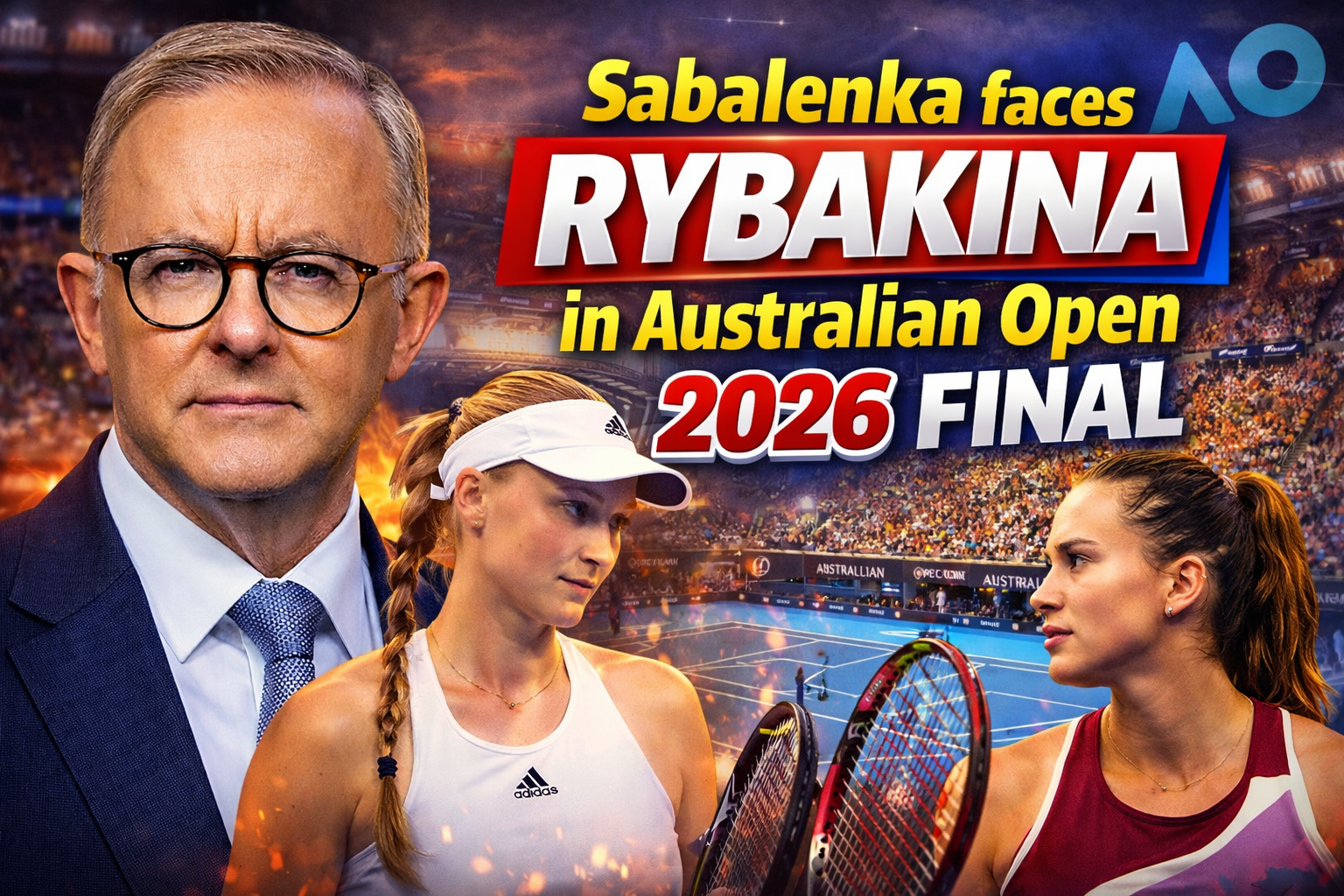
The women’s singles final at the Australian Open 2026 delivered a thrilling clash between world number one Aryna Sabalenka and former champion Elena Rybakina, reigniting their storied rivalry on the Rod Laver Arena stage.
Match Outcome
Aryna Sabalenka claimed victory in a gripping three-set battle, defeating Elena Rybakina with a final score of 6-4, 4-6, 7-5. The match lasted two hours and 45 minutes, showcasing baseline power duels and mental fortitude under Melbourne’s evening lights. Sabalenka’s third Australian Open title solidified her dominance Down Under, while Rybakina fought valiantly but fell short in the decisive third set.
Player Paths to Final
Sabalenka entered the final unbeaten in sets throughout the tournament until the championship match, powering through opponents with her signature aggressive baseline game. She started strong against qualifiers and lower seeds, dropping tight tiebreaks in the third round before cruising past seeded players in straight sets. Her semifinal demolition of Elina Svitolina in 6-2, 6-3 highlighted 29 winners and flawless serving.
Rybakina matched Sabalenka’s set perfection en route to the final, leaning on her flat groundstrokes and record aces. She dispatched early challengers efficiently, saving match points in a tense quarterfinal before edging Jessica Pegula 6-3, 7-6 in the semis. Both players arrived with perfect records this fortnight, setting up a rematch of their 2023 final.
Head-to-Head History
Sabalenka now leads their rivalry 9-6 after this win, having split four encounters last year. Rybakina’s recent WTA Finals triumph gave her momentum, but Sabalenka’s hard-court edge prevailed. Their matches often extend beyond two sets, averaging over two hours, with serve holds dominating play.
| Head-to-Head Breakdown | Sabalenka Wins | Rybakina Wins |
|---|---|---|
| Grand Slams | 2 | 1 |
| Hard Courts | 6 | 3 |
| 2025 Meetings | 2 | 2 |
| Three-Setters | 4 | 2 |
This table captures their balanced yet Sabalenka-favored dynamic, where tiebreaks and breaks prove pivotal.
Set-by-Set Recap
First Set: Sabalenka Edges Ahead
Sabalenka seized early control, holding serve comfortably while pressuring Rybakina’s delivery from the baseline. Rybakina fired five aces but committed uncharacteristic errors, gifting a break at 3-3. Sabalenka consolidated with a love hold, her forehand cross-court winners pinning Rybakina deep. At 5-4, Rybakina saved two set points with booming serves, but Sabalenka converted the third on a forehand error, taking the set after 48 minutes. Key stat: Sabalenka won 82% of first-serve points.
Second Set: Rybakina Strikes Back
Rybakina reset aggressively, breaking Sabalenka in the opening game with precise returns. The Kazakh held firm through mid-set, extending rallies to expose Sabalenka’s second serve. At 4-3, Sabalenka clawed back a break, only for Rybakina to retaliate immediately with a backhand down-the-line winner. Serving at 5-4, Rybakina faced deuce multiple times but sealed the set with an ace, leveling the match. She tallied 12 winners here, flipping momentum.
Third Set: Tense Decider
The decider began with mutual holds, both players landing 75% first serves. Sabalenka broke at 2-2 after a marathon game, her drop shots varying pace effectively. Rybakina responded at 4-3, forcing errors with deep returns. At 5-5, Sabalenka saved three break points in a 10-minute hold, then broke Rybakina at love in the next game. Serving for the match, she wobbled at 30-30 but closed with a massive forehand winner. Crowd erupted as Sabalenka dropped to her knees in triumph.
Key Statistics
Sabalenka’s power stats overshadowed Rybakina’s precision in the win.
| Statistic | Sabalenka | Rybakina |
|---|---|---|
| Aces | 8 | 14 |
| Double Faults | 4 | 3 |
| First Serve % | 68% | 72% |
| Winners | 42 | 38 |
| Unforced Errors | 31 | 28 |
| Break Points Converted | 4/9 | 3/7 |
| Total Points Won | 128 | 122 |
Sabalenka’s 42 winners marked her highest in a major final, while Rybakina’s 14 aces led the tournament. Both exceeded 300 total points played across their paths, underscoring endurance.
Serve and Return Analysis
Sabalenka’s serve averaged 115 mph, generating 12 break point opportunities. She converted crucial ones by rushing Rybakina’s backhand, winning 55% of return points. Rybakina’s flatter serves (topping 120 mph) held strong, but her second serve vulnerability (broken 40% of the time) proved costly. In rallies averaging nine shots, Sabalenka dictated with topspin forehands, forcing 18 errors off Rybakina’s weaker wing.
Tournament-wide, Sabalenka saved 75% of break points faced, while Rybakina led aces with 52 before the final. Their returns neutralized power, with Sabalenka’s aggression yielding a 62% rally win rate.
Rally Patterns and Tactics
Short points dominated early, with 40% ending in three shots or fewer due to big serves. Longer exchanges (over 10 shots) favored Rybakina’s consistency, comprising 25% of points. Sabalenka mixed slices and net approaches (winning 8/10), disrupting rhythm. Rybakina relied on down-the-line backhands, landing 15 such winners. Heat and humidity slowed the ball slightly, benefiting Sabalenka’s spin-heavy game in the third.
Turning Points
Five moments defined the match. First, Rybakina’s 0-40 lead in Sabalenka’s opening service game of set two, erased by two aces. Second, Sabalenka’s set point conversion after Rybakina’s net cord error. Third, the 5-5 hold in the decider, where Sabalenka aced under pressure. Fourth, Rybakina’s break back at 4-3 third set via a reflex volley. Fifth, the final game, where Sabalenka’s unreturned serve clinched it.
Player Reactions
Sabalenka, tearful in her on-court interview, credited her team’s mental prep: “Elena is a tough opponent; I had to fight every point.” She praised Rybakina’s serve, vowing to defend her world number one ranking. Rybakina, gracious in defeat, noted: “I played well but Aryna was stronger today. I’ll come back stronger.” Both highlighted their friendship amid rivalry.
Post-match, Sabalenka partied with fans, echoing her 2023 celebrations. Rybakina reflected on nearing a second major, eyes on upcoming hard-court swings.
Tournament Context
This final capped a grueling Australian Open featuring upsets and comebacks. Sabalenka’s path included tiebreak marathons, extending her hard-court final streak to seven. Rybakina’s ace barrage set records, her 52 total second only to her Wimbledon peak. Attendance hit 750,000, with finals night drawing 25,000 under lights. Prize money reached record highs, Sabalenka pocketing the champion’s cheque.
Career Milestones
Sabalenka’s third Australian Open triumph brings her Grand Slam tally to five, trailing only contemporaries in the power era. At 27, she joins an elite list of multi-time Melbourne winners. Rybakina’s runner-up finish boosts her to top-five contention, her third major final showcasing sustained elite form. Both remain unbeaten in 2026 majors until this decider.
Impact on Rankings and Season
Sabalenka cements world number one, extending her reign. Rybakina climbs to number three, primed for Doha defenses. Their rivalry promises more clashes, with WTA calendars favoring hard courts early. Sabalenka eyes a calendar slam pursuit, while Rybakina targets clay majors.
Fan and Expert Views
Crowd split loyalties, roaring for Rybakina’s upsets and Sabalenka’s flair. Experts lauded the baseline purity, calling it a modern classic. Social media buzzed with memes of their fist-pumps, stats threads dissecting serves. Analysts predict tighter margins in future meetings.
Legacy of the Rivalry
This rematch elevates Sabalenka-Rybakina among top rivalries, blending power and precision. Sabalenka’s 2023 win set the tone; 2026 adds depth. Future finals loom, potentially defining the post-Serena era.
Looking Ahead
Sabalenka rests briefly before Middle East swings, Rybakina eyes revenge in Dubai. Australian Open 2026 exits with a champion’s poise, baseline fireworks etched in Melbourne lore. Tennis fans anticipate more from these titans.

Vineeth T.C. is a news writer and digital content contributor at PageEuropean, covering key developments across New Zealand and Australia. His work focuses on delivering clear, fact-based reporting on current affairs, public policy, business updates, and regional news that matter to readers.