
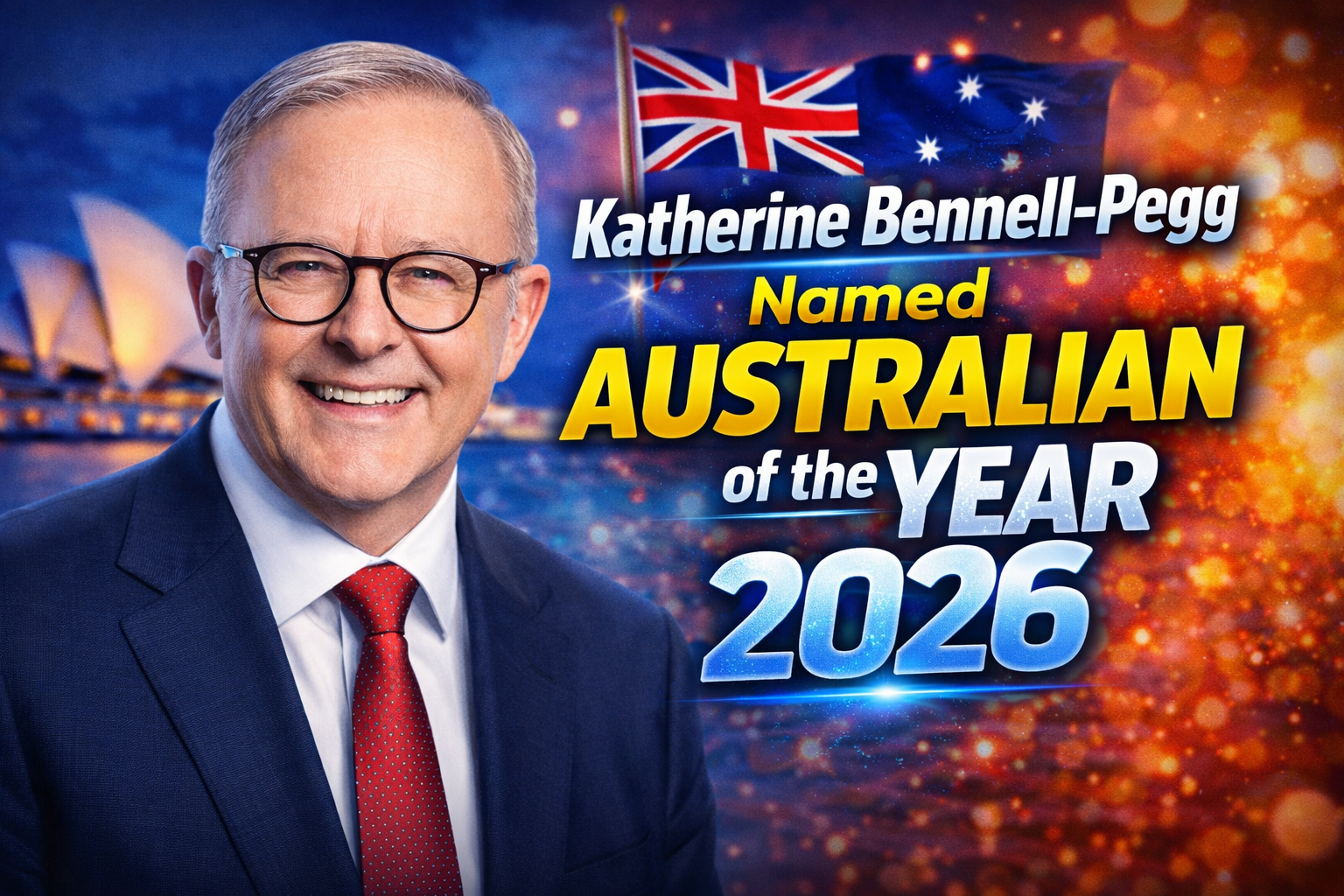
Katherine Bennell-Pegg, a trailblazing space engineer from South Australia, has been named the 2026 Australian of the Year, marking a historic milestone as the nation’s first qualified astronaut. Her achievement inspires a new generation, highlighting Australia’s rising presence in the global space race.
Award Announcement Ceremony
The announcement unfolded at the National Arboretum in Canberra amid a gathering of dignitaries, community leaders, and aspiring scientists. Prime Minister Anthony Albanese presented the honor on a crisp summer evening, praising Bennell-Pegg’s dedication to pushing boundaries in space exploration. The event celebrated not just individual excellence but Australia’s burgeoning space ambitions.
Other recipients included figures from diverse fields: a dementia researcher as Senior Australian of the Year, an endurance runner as Young Australian of the Year, and an Indigenous construction leader as Local Hero. Bennell-Pegg’s selection stood out, symbolizing innovation and national pride. Crowds cheered as she accepted the award, her speech weaving personal dreams with calls for collective inspiration.
The ceremony blended solemn recognition with festive elements, including performances and fireworks. Media coverage amplified the moment nationwide, positioning Bennell-Pegg as a beacon for STEM pursuits.
Early Life and Formative Years
Born in Adelaide, Bennell-Pegg nurtured astronaut dreams from childhood, gazing at stars during family camping trips. Growing up in a modest household, she balanced schoolwork with backyard experiments, disassembling radios to understand circuits. Teachers recall her insatiable curiosity, often staying late to debate physics concepts.
Her parents, both educators, encouraged exploration despite limited resources. School science fairs showcased early inventions, like a model rocket powered by household chemicals. This hands-on approach fueled her path, blending creativity with rigorous study. Scholarships enabled university entry, where she excelled in aerospace engineering.
Adelaide’s tight-knit community shaped her values—mateship, resilience, hard yakka. Early mentors in local tech firms introduced space concepts, igniting lifelong passion. These foundations propelled her from regional roots to international stages.
Educational and Professional Journey
Bennell-Pegg pursued dual degrees in engineering and physics at the University of Adelaide, graduating top of her class. Postgraduate research focused on satellite propulsion, earning accolades from the Royal Aeronautical Society. She interned with international agencies, honing skills in orbital mechanics and materials science.
Joining the Australian Space Agency early in her career, she rose swiftly. By her thirties, she directed space technology projects, overseeing mission designs for earth observation and deep-space probes. Her work advanced drought-resistant crop modeling and remote sensing for bushfire prediction.
In 2022, appointment as Space Technology Director solidified her leadership. She bridged government, industry, and academia, securing funding for national launch facilities. Collaborations with NASA and ESA amplified Australia’s voice, positioning it as a key player in Asia-Pacific space efforts.
Historic Astronaut Qualification
From over 22,500 applicants, Bennell-Pegg emerged as the standout, selected for Basic Astronaut Training at the European Astronaut Centre in Germany. Graduating in 2024 with a class of six, she became the first Australian—and first international trainee—to qualify under the national space program. Rigorous drills tested physical limits: zero-gravity simulations, survival training, high-G centrifuge runs.
Training spanned survival in hostile environments, from underwater analogs to Arctic mockups. She mastered spacecraft systems, robotics, and medical procedures for long-duration flights. Instructors praised her composure under pressure, blending technical prowess with team leadership.
This milestone opened doors for Australians, proving homegrown talent rivals global powers. Bennell-Pegg remains mission-ready, training with Defence while advocating for expanded programs. Her qualification underscores Australia’s investment in sovereign space capabilities.
Training Milestones Table
| Phase | Duration | Key Skills Acquired |
|---|---|---|
| Selection Process | 6 months | Aptitude tests, interviews |
| Basic Training | 12 months | Survival, systems, fitness |
| Advanced Sims | Ongoing | Robotics, EVA, medical |
| Certification | 2024 | Full astronaut qualification |
These stages highlight the grueling path, demanding excellence across disciplines.
Contributions to Space Technology
Bennell-Pegg pioneered advancements in reusable rocket components, reducing launch costs for small satellites. Her designs improved solar sails for interstellar probes, enhancing fuel efficiency. Projects addressed real-world challenges: climate monitoring via hyperspectral imaging, aiding precision agriculture.
She led development of ground stations for low-Earth orbit constellations, bolstering national security and disaster response. Collaborations yielded drought-tolerant gene edits tested in orbit, promising yields boosts for Australian farmers. Her patents span propulsion and life-support systems, licensed to startups.
Advocacy extended to policy, lobbying for increased space budgets. Bennell-Pegg testified before parliamentary committees, securing commitments for crewed missions by decade’s end. Her efforts diversified the workforce, with initiatives targeting women and regional youth.
Inspiration for STEM Education
A passionate educator, Bennell-Pegg visits schools weekly, captivating students with tales of zero-gravity flips and rocket blasts. Programs like “Space Kids” engage thousands, providing hands-on kits for home experiments. She demystifies complex topics—explaining relativity through everyday analogies like GPS navigation.
Partnerships with museums offer virtual reality tours of the International Space Station. Her message resonates: dreams demand grit, failures fuel progress. Girls’ STEM camps tripled attendance post her visits, narrowing gender gaps.
Social media amplifies reach, with live Q&As drawing global audiences. Bennell-Pegg mentors apprentices, many now in agency roles. Her platform elevates Australian stories, countering dominance by traditional space nations.
Outreach Impact Stats
| Initiative | Reach | Outcomes |
|---|---|---|
| School Visits | 500+ schools | 50,000 students inspired |
| Online Programs | 1 million views | 20% enrollment rise in STEM |
| Mentorship | 100+ apprentices | 80% retention in field |
These efforts quantify her transformative influence on youth.
Personal Life and Values
Balancing career demands, Bennell-Pegg maintains fitness regimes rivaling athletes—marathons, scuba dives, martial arts. She credits family for grounding: partner, a fellow engineer, shares stargazing rituals; siblings cheer missions. Adelaide home base keeps her connected to roots, hosting barbecues for team morale.
Hobbies include bushwalking and photography, capturing cosmic wonders from earthly vistas. Philanthropy supports remote Indigenous communities with satellite internet, bridging digital divides. Her faith in human potential drives advocacy for inclusive space exploration.
Resilience defines her: overcoming early rejections, she reframed setbacks as data points. This mindset permeates speeches, urging perseverance amid failures.
National and Global Recognition
The Australian of the Year title crowns prior honors: Order of Australia medal, international space fellowships. Media dubbed her “Aussie’s Space Pioneer,” with profiles in global outlets. Invitations pour in—from UN panels to TED stages—showcasing national talent.
Government leveraged her fame for space strategy launches, aiming for lunar bases and Mars analogs. Partnerships with private firms like Gilmour Space accelerate timelines. Internationally, she fosters alliances, eyeing joint missions with India and Japan.
Public response swelled pride: polls show boosted STEM aspirations, especially among youth. Her story humanizes space, proving ordinary origins yield extraordinary feats.
Challenges and Future Missions
Pathways bristled hurdles: funding cuts, gender biases, isolation from global hubs. Bennell-Pegg navigated by building networks, self-funding early training. Pandemic delays tested resolve, yet virtual sims honed skills.
Future beckons: potential Artemis program slots, Australian-led satellite swarms. She eyes orbital habitats solving earthly crises—clean energy, resource scarcity. Training intensifies, with hypoxia chambers and parabolic flights.
Bennell-Pegg vows using the award for advocacy: equitable access, ethical AI in space, environmental safeguards. Her vision: Australians leading humanity’s stellar leap.
Broader Implications for Australia
Her triumph signals space sector maturity, employing thousands in high-tech jobs. Exports grow—satellites to Asia, tech to Europe—fueling GDP. Regional hubs sprout in Queensland, Western Australia, democratizing opportunities.
Education reforms follow: curricula embed space science, scholarships surge. Gender parity advances, with women comprising half new trainees. Indigenous involvement rises via cultural astronomy programs.
Globally, Australia gains clout, joining G20 space talks. Bennell-Pegg embodies soft power—innovation diplomacy countering rivals.
Legacy and Lasting Impact
Katherine Bennell-Pegg redefines possible, etching Australian flags on space suits. Her journey—from Adelaide dreamer to national icon—inspires legions. As 2026 unfolds, she propels a space-faring nation forward.
Challenges persist, yet optimism prevails. Her story affirms: with determination, stars align. Australia stands taller, eyes heavenward, ready for cosmic adventures.

Vineeth T.C. is a news writer and digital content contributor at PageEuropean, covering key developments across New Zealand and Australia. His work focuses on delivering clear, fact-based reporting on current affairs, public policy, business updates, and regional news that matter to readers.