
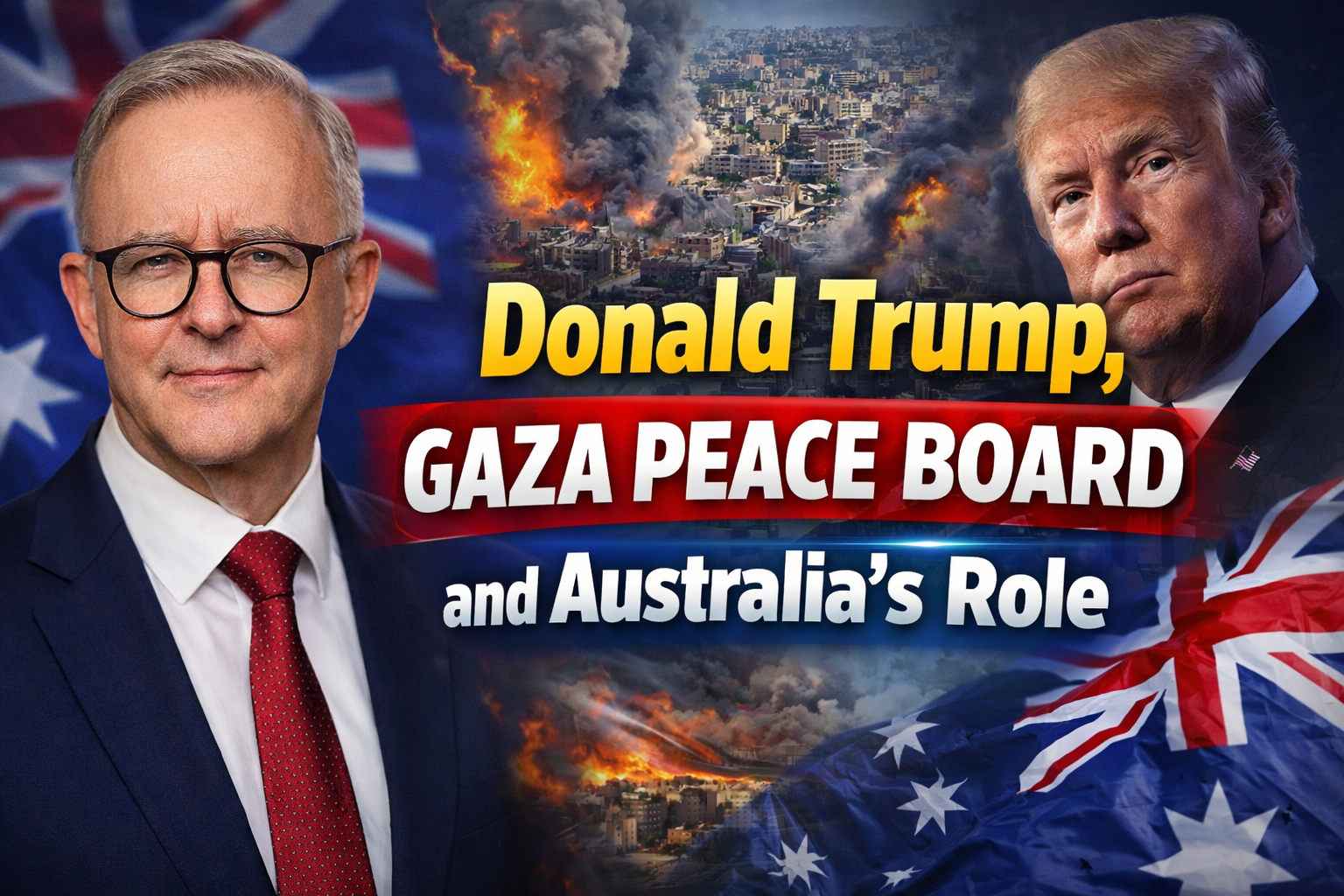
US President Donald Trump announced the formation of the Gaza Board of Peace on January 15, 2026, as a cornerstone of phase two in his 20-point Gaza peace plan, aiming to oversee governance, reconstruction, and long-term stability in the war-torn territory. The board, endorsed by UN Security Council Resolution 2803, includes high-profile figures like Jared Kushner, Steve Witkoff, former British PM Tony Blair, Turkish Foreign Minister Hakan Fidan, and Qatari diplomat Ali Al Thawadi, positioning it as a bold alternative to traditional UN mechanisms.
Australia’s Deputy Prime Minister and Defence Minister Richard Marles signaled cautious support on January 18, emphasizing alignment with US-led transitional frameworks while stressing the need for inclusive Palestinian input and Israeli security guarantees.
This development follows the October 2025 ceasefire, marking a shift from conflict to rebuilding amid global skepticism. Critics label it colonial oversight, but proponents see it as pragmatic deal-making to disarm Hamas, demilitarize Gaza, and attract investment. Australia’s stance reflects its strong US alliance under AUKUS, balancing Middle East ties with domestic calls for humanitarian focus.
Trump’s Gaza Board of Peace Explained
The Board of Peace operates as a three-tier structure: a main oversight body chaired by Trump, a Gaza Executive Board for daily operations, and a Palestinian technocratic committee for local administration. Announced via White House statement, it mobilizes funds for Gaza’s estimated $90 billion reconstruction, targeting housing, desalination plants, schools, and tech hubs within five years. Permanent seats require $1 billion commitments, while three-year terms come free, sparking debate over pay-to-play dynamics.
Key members bring deal-making heft: Kushner leverages Abraham Accords experience, Witkoff offers real estate expertise for rebuilding, and Blair provides diplomatic gravitas. Arab representatives like Fidan and Al Thawadi bridge Hamas and moderate Palestinians, while Israeli billionaire Yakir Gabay ensures Tel Aviv buy-in. Phase two mandates Hamas disarmament, international stabilization forces, and elections by 2028, with the board enforcing accountability through quarterly reports.
Trump frames it as a model for global conflicts, inviting nations like India, Hungary, Vietnam, and even Russia despite Ukraine tensions. Invitees receive letters highlighting UN backing, positioning the board as a UNSC rival amid US vetoes and funding cuts paralyzing traditional bodies.
The 20-Point Peace Plan Context
Trump’s plan, unveiled post-inauguration, builds on phase one ceasefire terms: hostage releases, IDF withdrawals to Gaza borders, and humanitarian corridors. Phase two escalates with governance overhaul—dissolving Hamas rule, installing NCAG (National Committee for Gaza Administration), and deploying multinational peacekeepers. Economic pillars promise Gulf investments for jobs, aiming to cut youth unemployment from 45% to under 10%.
Security features include demilitarized zones, AI-monitored borders, and joint US-Israel-Egypt patrols. Reconstruction phases prioritize Rafah and northern Gaza, with solar farms and ports funded by board pledges. Critics highlight power imbalances—no veto for Palestinians—and risks of indefinite US sway, but backers cite successes like UAE-Israel normalization.
Richard Marles and Australia’s Position
On January 18, during a Sydney press conference, Richard Marles voiced Australia’s “principled support” for the transition plan, pledging diplomatic engagement and potential humanitarian aid contributions. As Defence Minister, Marles tied it to AUKUS stability, noting Australia’s $1.2 billion annual US defense spending and shared Indo-Pacific interests. He urged “robust Palestinian representation” and stressed preventing escalation with Hezbollah or Iran.
Prime Minister Anthony Albanese echoed this, committing AUD 100 million in reconstruction aid via the board, focusing on water infrastructure and women’s programs. Foreign Minister Penny Wong plans Cairo consultations, balancing Labor’s pro-Palestinian base with bipartisan US alignment. Opposition Leader Peter Dutton praised Trump’s boldness, calling for faster Hamas dismantlement.
Australia’s role draws on Quad ties—India’s invite strengthens multilateralism—and ANZUS obligations. Marles hinted at ADF logistics support for peacekeepers, leveraging Townsville bases for training.
Australia’s Strategic Interests
Australia eyes Gaza stability to safeguard trade routes; 20% of exports pass Suez, disrupted by Houthi attacks. Energy security matters—LNG shipments to Asia avoid Red Sea risks. Domestically, 700,000-strong Muslim community pressures Labor on aid, while Jewish groups back anti-Hamas measures.
Geopolitically, backing Trump counters China’s Middle East inroads via Belt and Road. AUKUS pillar two (AI, quantum) benefits from US goodwill, with Gaza as a testbed for joint tech. Economically, Australian firms like CIMIC eye $10 billion contracts in Gaza ports and roads.
Australia’s Aid Commitments Snapshot
| Sector | Pledged Amount (AUD) | Focus Areas |
|---|---|---|
| Humanitarian | 50 million | Food, medical, tents |
| Infrastructure | 30 million | Desalination, solar grids |
| Education/Health | 20 million | Schools, women’s clinics |
| Total | 100 million | Phased over 3 years |
Global Reactions and Membership Dynamics
Invited nations react warily: India confirmed interest per PM Modi letter, eyeing broader conflict resolution roles. Hungary and Vietnam accepted, while Pakistan’s nod irks Israel. Russia got a Putin invite amid Ukraine stasis, raising eyebrows. Europe splits—UK’s Blair boosts credibility, but France demands UN primacy.
Israel critiques executive board overlaps with its policies, Netanyahu demanding veto power. Palestinians splinter: PA welcomes technocrats, Hamas decries occupation. Qatar and UAE pledge billions, tying to normalization.
Human rights groups slam colonial vibes, with Amnesty warning of Gaza apartheid risks. UN’s Guterres welcomes funds but insists on sovereignty.
Implications for Gaza Reconstruction
The board targets $50 billion by mid-2026, prioritizing 100,000 housing units and Khan Yunis revival. Tech integrations—drones for aid drops, blockchain for funds—promise transparency. Challenges loom: Hamas remnants, settler encroachments, and corruption histories.
Success hinges on Arab buy-in; Saudi hints at recognition post-plan. Long-term, Gaza as “Singapore of Levant” vision includes free trade zones, boosting GDP from $0.5 billion to $20 billion by 2035.
Board Membership Tiers
| Tier | Key Members | Role |
|---|---|---|
| Main Board | Trump (Chair), Rubio, Banga | Strategic oversight, funding |
| Executive Board | Kushner, Witkoff, Blair, Fidan | Operations, reconstruction |
| Gaza Committee | Technocrats, local reps | Daily governance, elections |
Challenges and Criticisms
Skeptics decry Trump’s lifelong chair as undemocratic, with $1 billion seats favoring oligarchs. Phase two risks power vacuums if Hamas resists, echoing Iraq 2003. Israel’s Gaza presence—20,000 troops—complicates withdrawals.
Humanitarian crises persist: 1.9 million displaced, famine warnings. Board’s colonial tag fuels boycotts, while Iran’s proxies threaten.
Australia’s Balancing Act
Marles’ support navigates Labor divisions—Greens blast “Trump’s quagmire.” Public polls show 55% favoring aid, 40% wary of entanglement. Wong’s diplomacy courts PA, ensuring aid reaches civilians.
ADF prep includes humanitarian training, with HMAS Sydney eyed for supply runs. Long-term, success bolsters Australia’s UNSC bid.
Regional and Global Ramifications
Gaza stabilization ripples: Quiets Houthis, eases Lebanon tensions, unlocks Abraham expansions. Trump’s model challenges UN, promoting deal-based diplomacy. For Australia, it affirms US pivot, countering Beijing.

Vineeth T.C. is a news writer and digital content contributor at PageEuropean, covering key developments across New Zealand and Australia. His work focuses on delivering clear, fact-based reporting on current affairs, public policy, business updates, and regional news that matter to readers.