
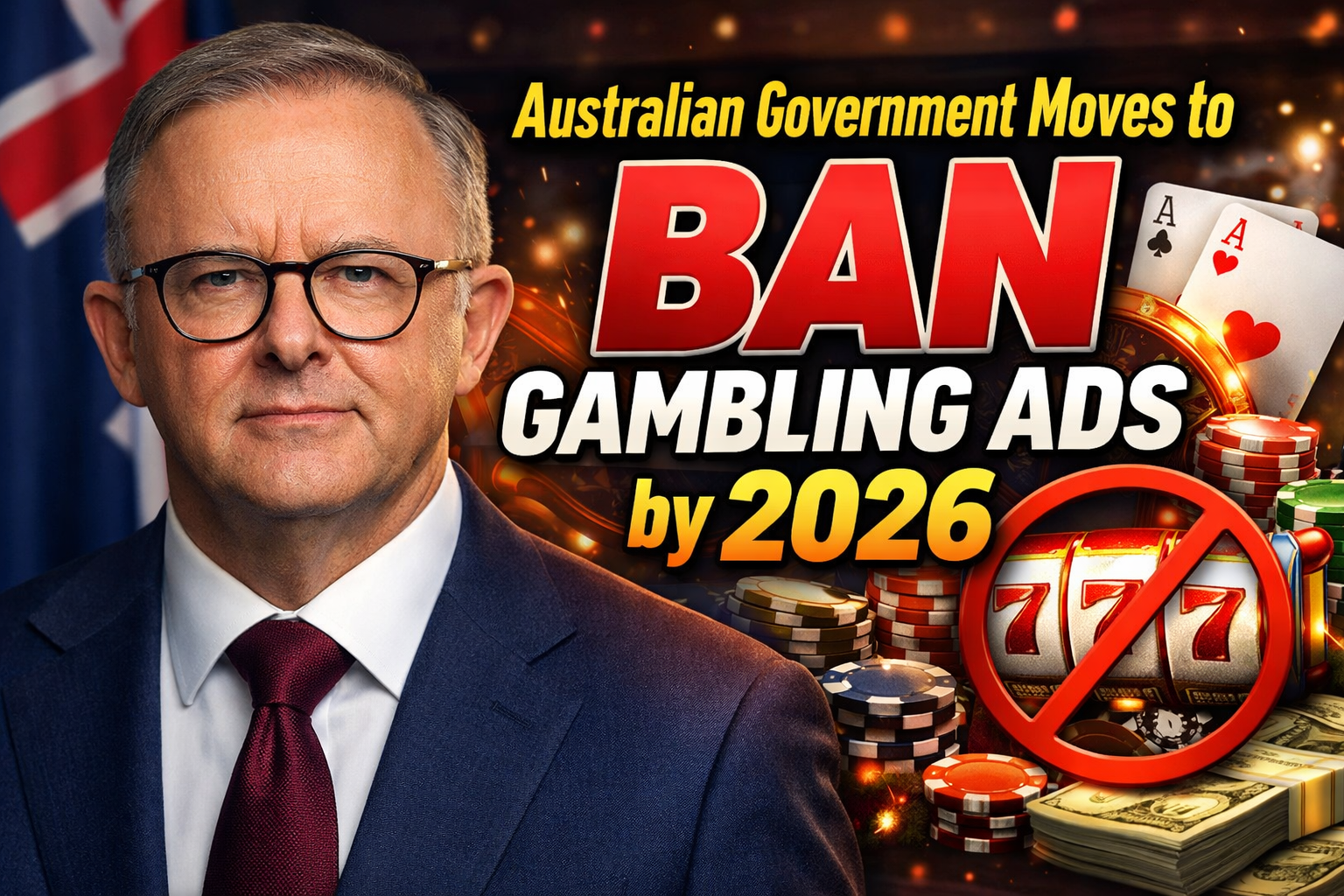
Australia is moving toward one of its most significant gambling advertising overhauls in years, with the federal government tightening restrictions across television, radio, sports venues, online platforms, and social media. The Australian Labor Party’s latest push aims not only to curb gambling promotion in mainstream media but also to rein in the growing role of influencers, podcasts, and digital creators who help wagering companies reach younger audiences.
The reform marks a major political shift. After years of criticism that gambling ads had become nearly unavoidable in Australian sports and digital life, the government is now trying to draw a line between adult choice and harmful exposure. The proposed changes are designed to reduce the visibility of gambling promotions, especially for children and teenagers who are most vulnerable to repeated advertising.
Why the crackdown matters
Gambling ads became everywhere
For many Australians, gambling promotions have become part of the background noise of modern sport and online entertainment. Betting brands have long sponsored football, racing, cricket, and major broadcasts, while apps, websites, and social media feeds have amplified their reach. That saturation has turned gambling advertising from a niche commercial practice into a broad public concern.
The government’s intervention reflects growing pressure from health advocates, parliamentarians, parents, and anti-gambling campaigners. Their argument is simple: when betting ads are constantly visible, gambling begins to look normal, low-risk, and routine, particularly to young people who have not yet developed the judgment to assess harm.
The debate is about harm, not just advertising
The new policy debate is not just about commercial speech. It is also about addiction, financial distress, family breakdown, and the long-term social cost of problem gambling. Australia already has one of the highest gambling loss rates per capita in the world, which makes the issue especially sensitive.
That context explains why the current reform push has received attention well beyond political circles. It touches on public health, sports culture, child protection, and the responsibilities of digital platforms that profit from targeted content.
Labor’s policy shift
From delay to action
The Australian Labor Party has faced criticism for taking too long to act after a parliamentary inquiry recommended stronger controls. For a long period, the party appeared cautious about confronting betting companies, sporting organisations, and media businesses that benefit from gambling-related revenue. The latest move suggests that caution is giving way to a more assertive position.
This shift is politically significant because it shows Labor trying to balance two competing pressures. On one side are reform advocates demanding stronger protections. On the other are sporting codes, broadcasters, and advertisers warning that a full ban could remove a major source of income.
A partial ban, not a total ban
Rather than eliminating gambling ads altogether, the government is pursuing a more limited model. The plan appears designed to sharply reduce exposure without completely dismantling the commercial ecosystem around sport and wagering. That means the policy is likely to be framed as a compromise rather than a prohibition.
Still, even a partial ban can have a major effect if it applies across stadiums, jerseys, broadcast windows, and social media platforms. The most consequential element may be the effort to stop gambling companies from using digital channels to bypass traditional media restrictions.
Influencers and social media
Why influencers are now in focus
The targeting of influencers reflects a broader reality: gambling companies have increasingly relied on social media personalities to reach younger, more digital-first audiences. Influencers can make betting content feel casual, funny, and personal, which can be far more persuasive than a conventional ad. That is precisely why regulators and lawmakers are paying attention.
In practice, social media promotion can be harder to police than television or radio advertising. Influencers may post sponsored stories, live streams, giveaways, or product mentions that blur the line between entertainment and advertising. The government’s move signals an attempt to close those loopholes.
Digital marketing has changed the game
Traditional gambling ads were easy to identify because they appeared in a commercial break or on a stadium sign. Social media promotion is much more fluid. A creator can casually reference a betting app, share a link, or subtly normalize wagering without producing a classic advertisement.
That is a major reason reformers want the rules extended into digital spaces. They argue that without social media restrictions, gambling firms will simply shift spending away from television and into influencer-driven campaigns, where oversight is weaker and audience engagement is stronger.
What the restrictions may cover
Broad platform coverage
The proposed crackdown is expected to reach a wide range of platforms and formats. That includes broadcast television, live sport, radio, sports venues, uniforms, social media, podcasts, apps, and possibly music and streaming platforms. The government is also considering age-based and login-based restrictions for online gambling content.
One of the most important ideas being discussed is the so-called triple-lock approach. This would require a user to be logged in, confirmed as an adult, and given the ability to opt out of gambling ads before such advertising could appear. That would be a major change to how online promotions are delivered in Australia.
Social and digital exposure table
| Area | Likely Restriction | Practical Effect |
|---|---|---|
| Television | Limits on gambling ad frequency | Fewer betting ads during prime viewing hours |
| Live sport | Ban during broadcasts | Reduced exposure during matches and commentary |
| Stadiums and jerseys | Prohibited sponsorship placement | Less brand visibility at sporting venues |
| Social media | Tighter rules for influencers and targeted ads | Fewer digital promotions to younger audiences |
| Podcasts and apps | Opt-out or login-based controls | Reduced direct marketing in personal media feeds |
| Radio | Restrictions during school travel times | Less exposure to children and families |
Industry impact
Revenue concerns are real
The gambling industry and its media partners are likely to resist any policy that cuts advertising volume. Betting companies rely on constant visibility to attract new users and keep existing customers active. Media outlets, especially sports broadcasters and podcasts, also benefit from wagering sponsorships and promotional deals.
That means the government is not just regulating ads. It is disrupting a revenue model. For sporting organisations and media platforms, the proposed restrictions may force a rethink of sponsorship strategies and content financing.
Sporting codes may feel the pressure
Australian sport has become deeply entwined with betting promotion. Many fans are accustomed to seeing gambling brands on jerseys, stadium boards, pre-match analysis, and match-day sponsorships. Removing those ads will likely hurt some revenue streams, especially for codes and clubs that have become dependent on them.
At the same time, the political mood appears to be shifting. Public tolerance for gambling saturation has fallen, and sports bodies may have to adapt to a more restrictive environment even if that means short-term financial pain.
Public health arguments
Children are the central concern
One of the strongest arguments for reform is the need to protect children from normalised gambling imagery. Repeated exposure to betting messages can shape attitudes before young people fully understand the risks. The government’s language around child protection suggests that this issue is likely to remain central to the policy debate.
Reform advocates argue that no other product with clear harm risks is promoted so aggressively during family sport. They say the normalisation of betting should be treated more like a public health issue than a standard marketing dispute.
Problem gambling remains a serious issue
Australia’s gambling losses remain exceptionally high, and problem gambling is linked to debt, stress, relationship breakdown, and mental health challenges. Critics of the current system say ads are not the only cause of harm, but they do act as a powerful reinforcement mechanism. In that sense, reducing exposure is seen as one of the most practical harm-minimisation tools available.
The argument for tighter controls is especially strong when digital targeting is involved. If algorithms can identify vulnerable users and push gambling content directly to them, then the case for regulation becomes harder to ignore.
Political and social tensions
Not everyone agrees on the scale of reform
Even within reform circles, there are disagreements about whether the government is going far enough. Some campaigners want an outright ban on gambling ads across all media, while others are prepared to support a phased reduction. The Labor Party’s approach appears designed to occupy the middle ground, but that may satisfy neither side completely.
Supporters of a total ban argue that partial restrictions will be easy to evade. Industry defenders argue that overly aggressive rules could damage sport and push audiences toward unregulated offshore operators. This tension will shape the next phase of the debate.
Influencers could become test cases
If the government tightens rules on digital promotion, influencers may become the most visible test case for enforcement. Social media creators often operate in a blurred regulatory space, where sponsorship disclosure, ad labeling, and platform rules do not always align neatly. That makes them a logical target for a crackdown.
For many creators, the issue is not just compliance but reputation. As public scrutiny rises, being associated with betting content may become less attractive, especially for influencers whose audiences include teenagers and young adults.
What happens next
Legislation and enforcement
The next stage will likely involve drafting formal legislation and defining how the rules will be enforced across different platforms. That is where the policy could become more complicated, especially because social media companies, streaming services, and podcast networks operate differently. A rule that works on television may not be easy to apply to a short-form video app or a creator-funded channel.
Enforcement will be crucial. If the government cannot monitor sponsored content, affiliate links, and native promotions effectively, the restrictions may lose much of their impact. That means regulators will need strong powers and clear cooperation from digital platforms.
A long-term reshaping of advertising
If the reforms are implemented as planned, Australia’s gambling advertising market will look very different by 2026. Brands may shift away from mass exposure and toward lower-profile digital channels, but even those routes are likely to face pressure. In the long run, the change could force a broader cultural reset around betting and sport.
That would be a major policy achievement for Labor if it can hold the line against industry pushback. It would also set a precedent for other countries facing similar concerns about gambling normalization in the digital age.
Conclusion
Australia’s move to ban or sharply restrict gambling ads marks a major turning point in how the country handles betting promotion. By targeting social media influencers as well as traditional broadcasters and sports venues, the Australian Labor Party is signaling that the digital age requires a broader definition of advertising harm.
The reforms are likely to be controversial, but they reflect a growing belief that gambling promotion has gone too far. Whether the final rules are strict enough to satisfy reformers remains to be seen, but one thing is clear: the era of unchecked betting ads in Australian life is ending, and the battle over how fast that happens is only beginning.

Vineeth T.C. is a news writer and digital content contributor at PageEuropean, covering key developments across New Zealand and Australia. His work focuses on delivering clear, fact-based reporting on current affairs, public policy, business updates, and regional news that matter to readers.