
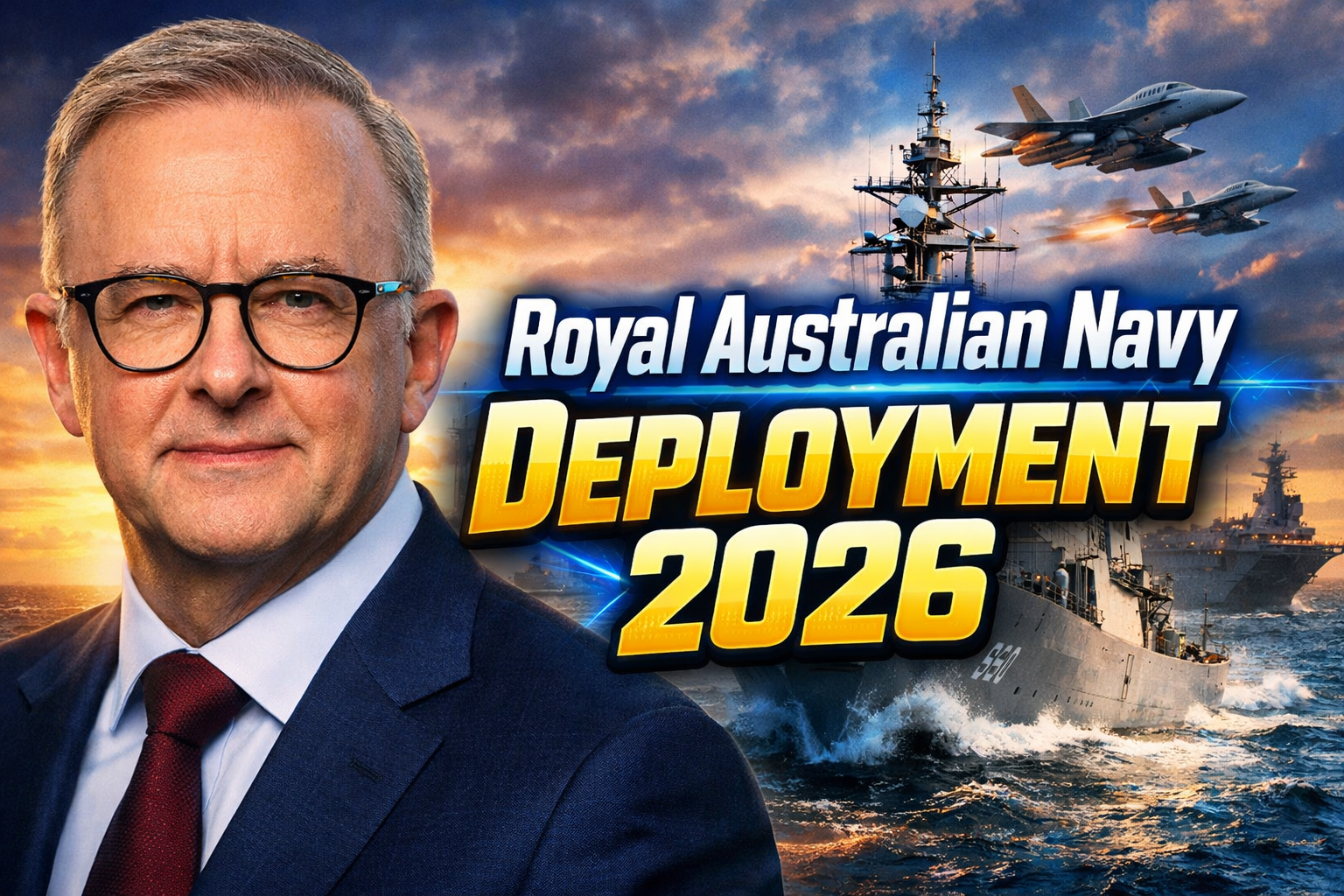
HMAS Toowoomba’s 2026 South China Sea deployment has become a clear demonstration of Australia’s continued commitment to regional security, freedom of navigation, and cooperation with Indo-Pacific partners. The Anzac-class frigate has completed multiple routine transits and maritime cooperative activities during its regional presence deployment, signaling that Canberra intends to remain active in one of the world’s most strategically sensitive waterways.
The mission is significant not just because of where it took place, but because of what it represents. The South China Sea remains a vital commercial route and a geopolitical flashpoint, and Australian naval operations there are closely watched by allies, partners, and regional competitors alike.
HMAS Toowoomba’s 2026 deployment
A busy regional presence mission
HMAS Toowoomba has been deployed as part of Australia’s 2026 regional presence operations across the Indo-Pacific. In February, the frigate conducted a routine transit through the South China Sea in accordance with international law, followed by further movements in the region as part of its broader maritime mission. The ship also completed a maritime cooperative activity with the Philippine Navy, Philippine Coast Guard, and the United States Navy after leaving Subic Bay in the Philippines.
By early April, Australia’s defence reporting confirmed that Toowoomba was still active in the South China Sea after engagements with the Republic of Korea, Japan, and Vietnam. That continuity shows the deployment is not a single passage, but a wider operational effort that connects training, diplomacy, interoperability, and maritime presence.
Safe and professional interactions
According to Australian defence reporting, the February transit took place without confrontation, even though foreign naval vessels were present in the area. The commanding officer described the interactions as safe and professional, underlining the Australian preference for disciplined and transparent movement through disputed or sensitive waters.
That detail matters because it frames the deployment as routine rather than provocative. Australia is signaling that its naval presence is intended to support rules-based navigation rather than escalate tensions.
Why the South China Sea matters
A key trade route
The South China Sea is one of the most important waterways in the world, carrying a large share of global trade. It links East Asia, Southeast Asia, and the wider Indian Ocean region, making it essential for energy supplies, manufactured goods, and food exports. Any disruption there would have consequences far beyond the immediate region.
Australia’s interest is therefore not abstract. As a trading nation, it relies on open sea lanes and predictable maritime access. That is why Canberra treats freedom of navigation as a practical economic and strategic issue, not just a diplomatic slogan.
A contested strategic space
The region is also a stage for competing territorial claims and military posturing. Several states claim overlapping maritime rights, and major powers regularly operate in the area to show presence and assert legal positions. That mix of commerce and confrontation makes even routine transits politically meaningful.
Australia’s approach is to keep its operations consistent with international law while avoiding unnecessary escalation. In practice, this means moving through the region, exercising with partners, and reinforcing the view that the sea should remain open to all lawful users.
Mission profile and partners
Cooperative activity with allies
One of the most important parts of Toowoomba’s deployment was the maritime cooperative activity involving the Philippines and the United States. These exercises strengthen communication, tactical coordination, and shared maritime awareness. They also show that Australia’s role in the Indo-Pacific is increasingly embedded in a network of allied and partner relationships.
The activity off the Philippines demonstrated how naval presence can serve diplomatic as well as military goals. Working alongside regional and extra-regional partners helps build interoperability, which is essential in any future crisis or humanitarian response.
A broader regional tour
Toowoomba’s deployment has not been limited to the South China Sea. Defence updates noted successful engagements with South Korea, Japan, and Vietnam as part of the wider regional presence mission. That broader itinerary reveals a pattern of layered diplomacy, where the ship acts as both a platform for defence cooperation and a symbol of sustained Australian engagement.
This type of deployment is useful because it blends hard and soft power. The ship can contribute to deterrence and readiness while also reinforcing trust with partners through visits, exercises, and professional naval interactions.
Australia’s strategic message
Support for the rules-based order
Australian defence officials have repeatedly said these deployments are meant to protect national interests, preserve the rules-based order, and support a peaceful and stable Indo-Pacific. That language is important because it places the mission within a legal and diplomatic framework rather than a confrontational one.
The message is that Australia will continue to operate where it is permitted to operate under international law. This is meant to reassure allies and signal resolve to any actor seeking to restrict lawful navigation or reshape maritime norms through pressure.
Presence as deterrence
Naval presence matters because it communicates commitment without requiring conflict. A frigate transiting the region regularly, and doing so in coordination with partners, sends a visible signal that the sea lanes are being watched and that Australia is prepared to be part of any collective response to instability.
That deterrent effect is subtle but real. It helps reduce the chance that any one actor assumes the region is uncontested or politically abandoned.
Deployment details at a glance
| Aspect | Detail |
|---|---|
| Ship | HMAS Toowoomba |
| Class | Anzac-class frigate |
| Mission | Regional presence deployment |
| Key area | South China Sea |
| February activity | Routine transit in accordance with international law |
| Partner engagement | Maritime cooperative activity with the Philippines and the United States |
| Wider contacts | Republic of Korea, Japan, and Vietnam |
| Strategic purpose | Interoperability, presence, and support for regional security |
Regional reactions and risks
Cautious but visible presence
Australian operations in the South China Sea are generally designed to be professional, legal, and limited in scope. That cautious posture helps reduce the risk of direct confrontation while still ensuring the Australian navy remains active in a region of high strategic importance. The emphasis on routine transits also helps frame the mission as normal maritime business rather than a political stunt.
Still, any foreign naval activity in the South China Sea can attract attention. Even when there is no confrontation, the presence of foreign warships is noticed closely by other regional militaries and by governments watching for signs of alignment or escalation.
The risk of miscalculation
The biggest operational risk in the South China Sea is often not deliberate conflict but miscalculation. Crowded sea lanes, overlapping military activity, and politically sensitive waters can create situations where a small mistake becomes a diplomatic incident. That is why disciplined ship handling, clear communications, and adherence to maritime law are so important.
Toowoomba’s reported safe transit shows the value of professional procedures. It also demonstrates how a well-managed naval mission can reduce risk even in a contested environment.
Navy readiness and capability
A demanding operational cycle
The deployment also highlights the strain placed on Australia’s surface fleet. Anzac-class frigates are versatile, but they are also aging platforms being used heavily across multiple operational commitments. Long-distance regional deployments, combined with exercises and maritime security tasks, place real demands on maintenance schedules and crew endurance.
That does not reduce the importance of the mission, but it does show that Australia is relying on a fleet that must do a great deal with limited numbers. The South China Sea deployment is therefore both a strategic success and a reminder of the pressure on naval capability.
Interoperability as a force multiplier
One of the biggest gains from these missions is interoperability. When Australian ships operate alongside partners such as the Philippines and the United States, they improve shared procedures, communication standards, and operational confidence. That makes future cooperation easier, whether in maritime security, disaster response, or crisis management.
For a middle power like Australia, interoperability is a force multiplier. It allows the navy to achieve more by operating as part of a wider network rather than as a standalone force.
What it means for 2026
A year of continued maritime engagement
HMAS Toowoomba’s deployment suggests that 2026 will remain a year of active maritime engagement for Australia. The ship’s repeated presence in the South China Sea, combined with wider regional visits, shows that Canberra is not stepping back from the Indo-Pacific. Instead, it is choosing to stay visible, connected, and operationally engaged.
That matters at a time when the region is watching for shifts in U.S., Chinese, and allied naval behavior. Australia’s contribution may be smaller than that of the largest powers, but it still carries diplomatic weight.
A message of consistency
The most important thing about Toowoomba’s mission may be its consistency. Australia is showing up, staying professional, and reinforcing a legal principle rather than making dramatic gestures. In an era of uncertainty, that kind of steady presence can be more valuable than headline-grabbing moves.
It tells partners that Australia is reliable. It also tells rivals that the country intends to keep operating in accordance with international law, even in contested waters.
Conclusion
HMAS Toowoomba’s 2026 South China Sea deployment is a clear example of Australia’s strategy in action: steady naval presence, close partner coordination, and support for open sea lanes under international law. The frigate’s routine transits and cooperative activities show that Australia is treating the Indo-Pacific as a core arena for diplomacy, deterrence, and defence cooperation.
The mission also reflects the wider realities of the region. The South China Sea remains crowded, contested, and strategically vital, which means every deployment carries meaning. For Australia, the value of HMAS Toowoomba lies not only in the miles sailed, but in the message it sends about commitment, professionalism, and regional stability.

Vineeth T.C. is a news writer and digital content contributor at PageEuropean, covering key developments across New Zealand and Australia. His work focuses on delivering clear, fact-based reporting on current affairs, public policy, business updates, and regional news that matter to readers.