
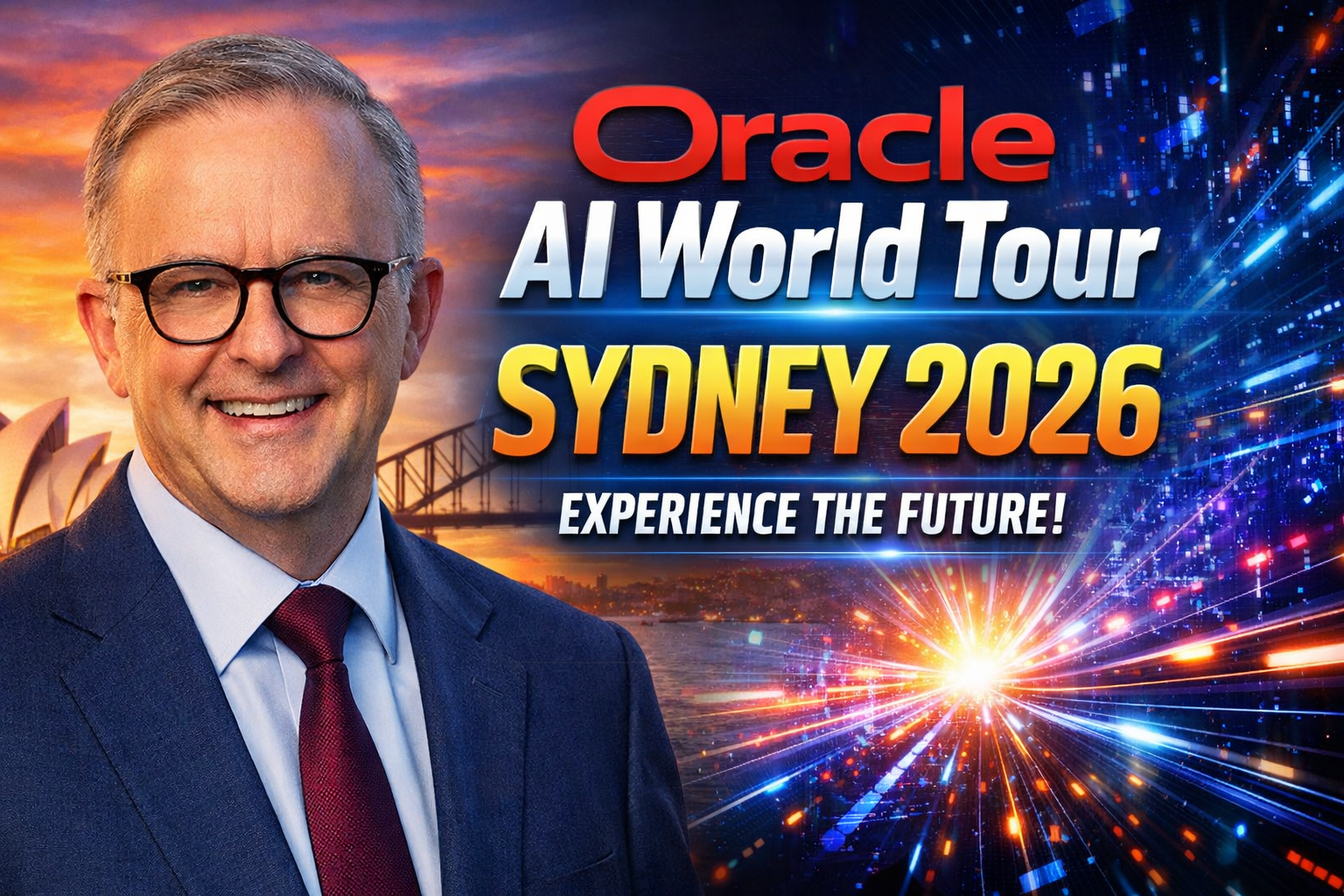
On 24 March 2026, Sydney became the regional nerve centre for Oracle’s push into the next phase of enterprise AI. The Oracle AI World Tour stop at ICC Sydney did more than showcase a series of cloud‑and‑AI keynotes; it formally launched the Oracle AI Customer Excellence Centre (AI CEC) and positioned an AI‑centric innovation hub as the beating heart of Oracle’s strategy across Australia and Oceania. For businesses grappling with AI‑driven transformation, the event offered a concrete glimpse of how Oracle plans to move organisations from pilot projects to production‑scale intelligence.
The Big Picture of Oracle AI World Tour Sydney
Oracle AI World Tour Sydney 2026 is part of a global series of one‑day, in‑person events that bring together Oracle executives, partners, and customers to explore how AI is reshaping cloud applications, data platforms, and infrastructure. The Sydney stop is notable because it sits at the intersection of a booming regional AI market and Oracle’s long‑standing footprint in ANZ enterprise software. The day’s agenda mixed technical deep‑dives with strategic roadmaps, vendor showcases, and customer stories, all orbiting around three core themes: automation, governance, and revenue‑driven AI.
What set the Sydney event apart from previous Oracle tours was the emphasis on local context. Speakers repeatedly referenced Australia’s financial‑services penetration, healthcare digitisation needs, and public‑sector modernisation efforts, all as potential beachheads for AI‑infused cloud and database workloads. Sponsors such as DXC, Wipro, and Capgemini used the event to demonstrate how they are embedding Oracle’s AI tools into their own offerings, effectively turning the tour into a mini‑ecosystem summit as much as a product showcase.
Launching the AI Customer Excellence Centre
Announced on stage during the AI World Tour, the Oracle AI Customer Excellence Centre is a Sydney‑based facility designed to act as a regional hub for AI‑driven business transformation. Oracle describes the AI CEC as a place where customers, partners, and internal teams can train, experiment, and co‑design AI initiatives rather than simply buying off‑the‑shelf cloud services. The centre is positioned as a bridge between conceptual AI strategies and operational AI deployment, with a strong focus on practical upskilling and pilot programmes.
Inside the AI CEC, visitors will encounter a mix of classroom‑style training areas, collaborative co‑creation labs, and demonstration zones. The centre is structured so that teams can access blended learning paths that combine Oracle Cloud Infrastructure, AI‑enabled applications, and data‑governance tooling. Training modules are aimed at a broad audience: business leaders needing to understand AI’s impact on their KPIs, data engineers who want to build and orchestrate AI pipelines, and citizen developers who prefer low‑code interfaces to experiment with AI‑powered workflows.
A central theme Oracle emphasised was “moving beyond ideas into execution.” The AI CEC is not a theoretical research lab; it is meant to help organisations rapidly translate AI strategies into real‑world pilots and proofs of concept. This includes lightweight sandbox environments where teams can test generative‑AI features, intelligent automation, and data‑driven analytics against their own anonymised workloads. For many enterprises, the value of the centre lies in risk‑reduced experimentation: organizations can validate AI‑driven processes before committing significant capital to enterprise‑wide rollouts.
Inside the AI Innovation Hub
Complementing the AI Customer Excellence Centre is the notion of an AI Innovation Hub, a more fluid, partner‑driven environment that runs alongside the formal CEC. The hub is not a single physical building but rather a curated ecosystem of Oracle’s cloud‑native AI assets—GenAI‑enabled applications, data platforms, and infrastructure—combined with partner accelerators and consulting frameworks. At the Sydney event, the hub came to life through partner‑led sessions, live demos, and vendor booths that illustrated how Oracle’s AI stack can be plugged into specific industries.
In the hub, visitors encountered a series of modular playbooks for different use cases. For banking, there were demos of AI‑driven fraud detection sitting on top of Oracle Autonomous Database; for retail, there were use cases around personalisation and supply‑chain forecasting powered by Oracle Fusion Cloud Applications. The hub also spotlighted industry‑specific accelerators from partners who have built AI‑enabled extensions, such as low‑code AI‑workbench tools or industry‑tailored analytics dashboards that run on Oracle Cloud Infrastructure.
What makes the Innovation Hub concept appealing is its “plug‑and‑play” orientation. Rather than asking customers to build AI capabilities from scratch, Oracle and its partners are packaging AI‑ready workflows, reference architectures, and integration patterns. This reduces the initial learning curve and helps organisations focus on business outcomes rather than plumbing. For example, a participant in the Sydney event could walk away with a clear picture of how to layer AI‑driven customer‑service bots on top of existing Oracle CX platforms, complete with sample data models and governance templates.
Skills, Governance, and the Agentic AI Enterprise
A recurring motif at the Sydney stop was the “Agentic AI Enterprise”—Oracle’s evolving vision of organisations where AI agents operate semi‑autonomously across applications, data sources, and workflows. This concept underpins much of the AI CEC’s design. The centre is structured to help teams think about delegation, escalation paths, and guardrails for AI agents, rather than simply building isolated chatbots or recommendation engines.
Training content inside the AI CEC stresses data literacy, prompt engineering, and AI governance. Courses are tailored to help business users understand how to frame AI tasks, evaluate model outputs, and spot potential risks such as hallucinations or bias amplification. At the same time, technical tracks focus on how to secure AI‑enabled architectures, monitor model drift, and integrate AI components into existing enterprise‑security frameworks. Oracle’s message is that trust and control are not add‑ons; they are prerequisites for scaling AI at an organisational level.
Partner‑led sessions further reinforced this governance‑first mindset. For example, DXC’s hub‑theatre presentation highlighted how its AI Workbench, built on Oracle Cloud, aims to streamline AI development while enforcing consistent governance across multiple business units. Other partners showcased how they layer policy‑as‑code and compliance‑by‑design practices into AI deployments, ensuring that AI‑driven decisions align with regulatory requirements in financial services, healthcare, and government.
Practical Use Cases and Customer Stories
The Sydney event’s impact rested as much on concrete examples as on conceptual frameworks. Oracle featured several customer stories that illustrated how existing Oracle customers are using AI to accelerate digitisation without abandoning their core transactional systems. One example focused on a major Australian bank using AI‑augmented analytics on top of Oracle Financial Services software to detect complex fraud patterns more quickly. Another showcased a large retailer leveraging Oracle Retail AI capabilities to optimise inventory, pricing, and promotions in near real time.
Across industries, the pattern Oracle highlighted was “AI on top of existing core.” Rather than treating AI as a separate, siloed initiative, Oracle’s narrative is about embedding intelligence into mature enterprise systems: ERP, HR, CX, risk, and supply‑chain platforms. This approach aligns with the reality of many Australian and New Zealand organisations, which have heavily invested in Oracle’s core applications over the past decade. By framing AI as an evolution rather than a rip‑and‑replace, Oracle positions the AI CEC as a safe space to experiment without disrupting mission‑critical operations.
Customers attending the World Tour also had the chance to see how AI can be applied to modernisation projects. For legacy‑application modernisation, Oracle showcased refactoring tools that combine AI‑driven analysis with cloud‑native containerisation. For data‑modernisation, there were demos of AI‑assisted data‑lineage and catalog‑management features that help organisations map complex data ecosystems and enforce governance rules automatically. These use cases tie directly into the AI CEC’s mission: they are exactly the kinds of pilots that benefit from a sandbox environment, guided experimentation, and expert coaching.
Why Sydney Matters for Oracle’s AI Strategy
Sydney’s elevation to host the AI Customer Excellence Centre and anchor the AI World Tour reflects both regional demand and strategic positioning. Australia and New Zealand are seeing rapid uptake of cloud‑based AI, but many organisations remain cautious about implementation at scale. The AI CEC effectively de‑risk transformation by offering a local, hands‑on resource where businesses can test, train, and iterate without the pressure of a full‑blown deployment. This is particularly valuable for remote and regional enterprises that may lack in‑house AI talent but still want to participate in the AI‑driven economy.
Beyond skills, the Sydney hub also strengthens Oracle’s partner ecosystem. By colocating the AI CEC with partner innovation activities, Oracle creates a shared environment where vendors can co‑build solutions, run joint labs, and demonstrate interoperability. This ecosystem effect multiplies the value of the centre, turning it into a meeting point between Oracle’s technology stack and the bespoke capabilities of local and global partners.
Looking Ahead: From Tour to Transformation
The Oracle AI World Tour Sydney 2026 was more than a one‑day event; it was the launchpad for an ongoing shift in how Oracle engages with its ANZ customer base. The AI Customer Excellence Centre and the associated AI Innovation Hub are designed as long‑term assets, not short‑term marketing theatrics. For businesses that attended, the most important takeaway was the availability of a structured path from experimentation to enterprise‑scale AI adoption.
In the months ahead, the impact of the Sydney launch will depend on how actively organisations engage with the AI CEC. Those who treat it as a continuous learning and experimentation resource—using it to run pilots, upskill teams, and refine governance frameworks—are likely to see the most tangible returns. For Oracle, the Sydney stop is a signal that the AI‑era is no longer about discrete features or incremental upgrades; it is about embedding intelligence throughout the enterprise and giving customers the tools, the hub, and the centre to make it real.

Vineeth T.C. is a news writer and digital content contributor at PageEuropean, covering key developments across New Zealand and Australia. His work focuses on delivering clear, fact-based reporting on current affairs, public policy, business updates, and regional news that matter to readers.