
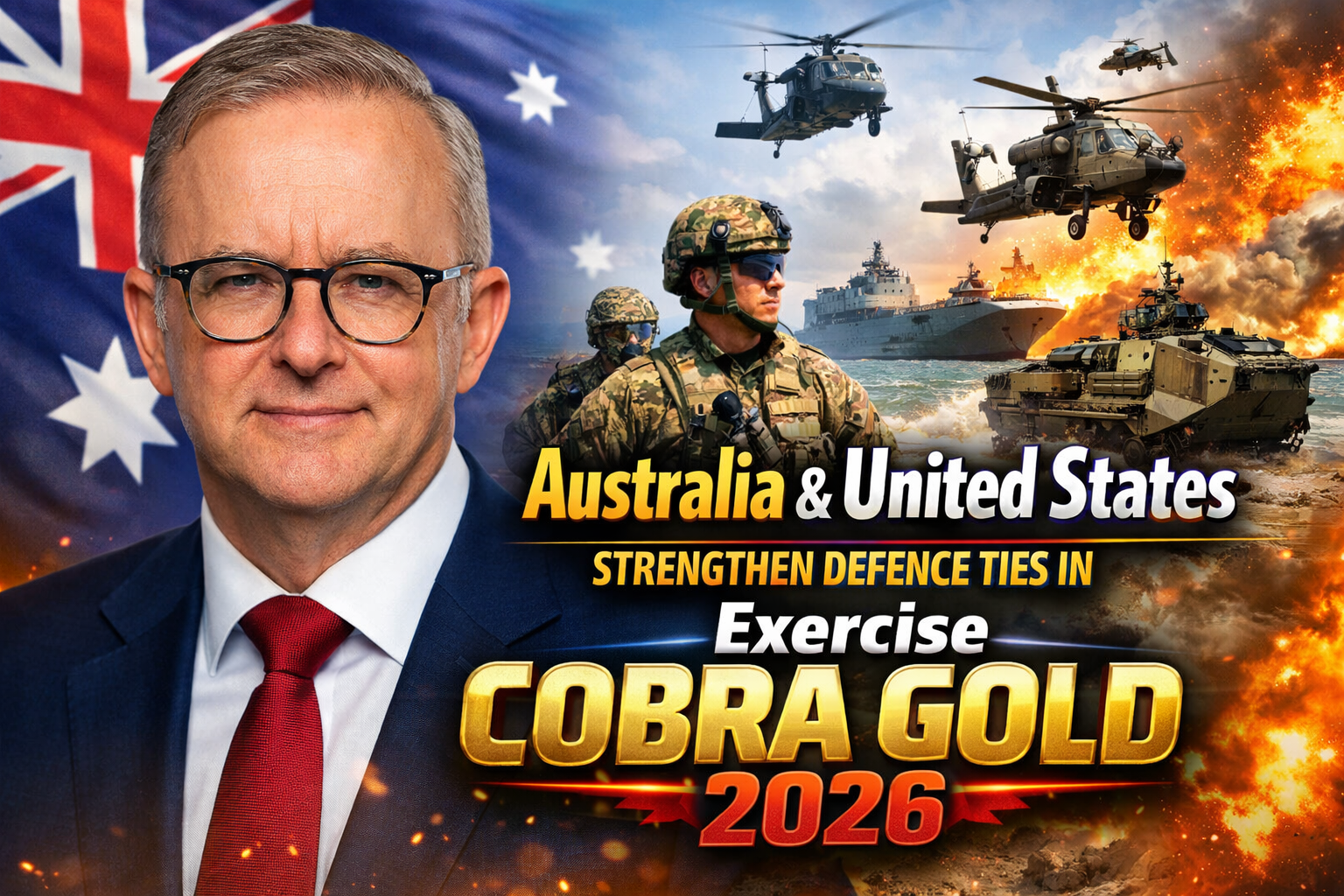
Australia and the United States deepened their defence partnership during Exercise Cobra Gold 2026, emphasizing seamless integration across space, cyber, and conventional military domains. Held in Thailand, the multinational drill showcased how allied forces are adapting to modern multidomain warfare in the Indo-Pacific.
Overview of Exercise Cobra Gold 2026
Cobra Gold stands as Southeast Asia’s premier military exercise, co-hosted annually by Thailand and the United States since 1982. The 2026 edition ran from February 23 to March 6, drawing over 8,000 personnel from 30 nations including core partners like Japan, South Korea, Indonesia, Singapore, and Malaysia. Activities spanned land, sea, air, cyber, and space operations, simulating responses to small-scale contingencies and humanitarian crises.
This year’s focus shifted toward joint headquarters integration, with Australian Defence Force personnel embedding into multinational command structures. The exercise tested realistic scenarios in Rayong and other Thai sites, enhancing interoperability amid rising regional tensions. Chief of Joint Operations Vice Admiral Justin Jones highlighted its role in building a “joint integrated force” for Indo-Pacific security.
Australia’s Key Contributions and Deployments
The ADF dispatched around 19 specialists to Cobra Gold’s multinational headquarters, prioritizing space and cyber expertise. These personnel contributed to command and control, fusing data from diverse domains to simulate contested environments. Their involvement underscored Australia’s evolution from traditional contributor to multidomain leader.
Integration occurred at tactical and operational levels, with Aussies liaising alongside US Space Command and Cyber Command elements. Ground elements practiced amphibious assaults, while air assets coordinated strikes. This marked a step up from prior years, reflecting Defence Strategic Review priorities for optimised space capabilities through alliances.
| ADF Deployment Breakdown | Role | Focus Areas |
|---|---|---|
| Headquarters Staff | Command Integration | Space/Cyber Ops |
| Specialist Teams | Domain Awareness | Satellite Tracking, Network Defense |
| Support Personnel | Logistics/Enablers | Multinational Sustainment |
| Total: ~19 | Multidomain Fusion | Indo-Pacific Scenarios |
United States-Australia Space Cooperation
Space domain awareness emerged central, building on AUSMIN commitments to elevate the domain within ANZUS frameworks. US forces shared advanced satellite surveillance, while Australians provided regional insights from their growing constellation. Drills simulated anti-satellite threats, orbital debris mitigation, and GPS jamming countermeasures.
Joint training integrated ADF’s nascent Defence Space Command with US Space Force units, testing resilient architectures. Technologies like optical ground stations and RF spectrum monitoring fused real-time battlespace pictures. This cooperation offsets Australia’s sovereign gaps, leveraging US tech transfers including launch data sharing.
Enhanced Space Cooperation, a Force Posture Initiative, enables co-development of hypersonic trackers and quantum-secured links. Exercises validated these in live-fire scenarios, ensuring allies operate as one force in orbit.
Cyber Domain Integration and Scenarios
Cyber operations wove through all phases, mimicking hybrid attacks on critical infrastructure. Teams defended simulated networks against ransomware, DDoS floods, and supply chain compromises targeting Thai-US-Australian grids. ADF cyber warriors integrated with US Cyber Command’s Joint Cyber Warfighting Architecture, sharing threat intelligence via secure clouds.
Scenarios escalated to offensive cyber support for kinetic strikes, disrupting adversary C4ISR without attribution. Multinational cells practiced “left-of-boom” defenses, pre-empting hacks on shipping lanes and airfields. Australia’s expertise in Pacific cyber norms shone, advocating rules-based approaches.
Interoperability shone in toolsets: common SIEM platforms and AI-driven anomaly detection allowed seamless handoffs. Post-exercise, partners pledged expanded red-team exchanges.
| Cyber Exercise Elements | Threats Simulated | Outcomes |
|---|---|---|
| Defensive Ops | DDoS, Phishing | 95% Mitigation Rate |
| Offensive Support | C4ISR Disruption | Real-Time Fusion |
| Resilience Training | Supply Chain Attacks | Cross-Domain Alerts |
Multidomain Military Synergies
Cobra Gold fused domains holistically: space assets cued cyber intrusions, which informed air-naval strikes. US Marines and Thai forces executed amphibious landings under simulated satellite blackout, relying on cyber-hardened backups. Australian planners orchestrated joint fires, blending HIMARS with F-35 data links.
Live-fire drills countered maritime drones, a nod to Red Sea threats, with US-Australian sensors guiding intercepts. Humanitarian segments practiced disaster relief, using space imagery for aid routing amid cyber-disrupted comms.
This multidomain approach mirrors AUKUS Pillar II, accelerating autonomy and AI in contested spaces. Over 30 nations synchronized, proving coalition scalability.
Strategic Importance for Indo-Pacific Security
The exercise counters gray-zone coercion, from South China Sea incursions to Taiwan contingencies. Space-cyber vulnerabilities amplify risks; integrated defences deter escalation. Australia’s participation signals reliability, bolstering US extended deterrence.
Regional partners like Thailand gain from tech exposure, fostering a web of aligned capabilities. Cobra Gold validates planning for complex ops, enhancing deterrence without provocation.
| Participating Nations | Core Contributors | Observers |
|---|---|---|
| Thailand, USA, Australia | 7 Nations | 23 Others |
| Japan, ROK, Indonesia | Multidomain Experts | Indo-Pacific Allies |
| Singapore, Malaysia | Humanitarian Focus | Global Partners |
Technological Innovations Showcased
Allies demoed next-gen tools: US Space Development Agency’s proliferated satellites linked with Australian optical terminals for low-latency relays. Cyber teams tested zero-trust architectures against quantum threats. Drones swarmed under space-directed autonomy, evading jamming.
AI fused sensor feeds, predicting adversary moves. Quantum key distribution secured voice loops, a first in exercises. These previews align with US-Australia tech-sharing pacts, fast-tracking fielding.
Challenges and Lessons Learned
Integration revealed frictions: disparate data standards slowed fusion, prompting API harmonization pledges. Bandwidth constraints in cyber-contested scenarios demanded edge computing. Cultural variances in command styles necessitated trust-building.
Vice Admiral Jones noted invaluable “individual experience” gains, with Aussies honing multinational ops. After-action reviews prioritize space-cyber doctrine alignment.
Broader Implications for AUSMIN and AUKUS
Cobra Gold feeds into AUSMIN’s Enhanced Space Cooperation, embedding domains in alliance postures. It complements AUKUS by proving cyber-space enablers for nuclear subs. US-Australia ties extend to Japan, expanding trilateral space tracking.
Long-term, exercises like Talisman Sabre will scale these lessons, integrating Pine Gap’s signals intel.
Regional Partnerships and Thai Hosting
Thailand’s leadership shone in Thai-led headquarters, balancing US heft with ASEAN centrality. Over 8,000 troops executed flawlessly, from beach assaults to cyber ranges. Partners like Japan contributed space assets, enriching the tapestry.
Humanitarian projects—village builds, medical civics—softened the exercise’s edge, winning local hearts.
Future Directions in Multidomain Defence
Post-Cobra Gold, allies eye annual space-cyber tracks, with Australia hosting simulations. Investments target resilient constellations and AI battle management. Doctrines evolve toward “mosaic warfare,” where domains self-synchronize.
This iteration cements Australia-US leadership, readying coalitions for high-end fights. As threats proliferate, integration ensures free, open Indo-Pacific.

Vineeth T.C. is a news writer and digital content contributor at PageEuropean, covering key developments across New Zealand and Australia. His work focuses on delivering clear, fact-based reporting on current affairs, public policy, business updates, and regional news that matter to readers.