

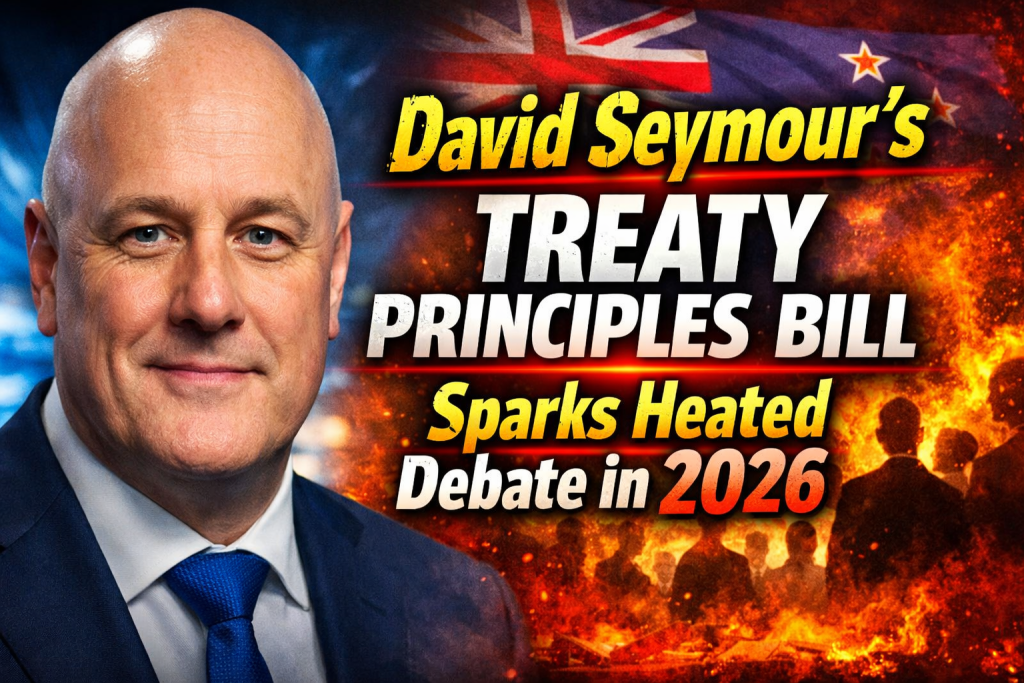
David Seymour, ACT Party leader and Deputy Prime Minister, reignited controversy over his Treaty Principles Bill in early 2026, vowing to thrust equal rights under the Treaty of Waitangi back into the election spotlight. Despite defeat at second reading in 2025 after massive public backlash, Seymour insists the debate fosters national unity through clarity. This standoff divides Kiwis, pitting calls for universal equality against fears of undermining Māori partnership, with profound stakes for New Zealand’s social fabric and politics.
Bill Background
Introduced in November 2024 under coalition agreement, the bill stemmed from ACT’s 2022 policy to legally define Treaty principles amid co-governance debates. A leaked Justice Ministry memo warned it clashed with Treaty text, sparking early fire. Passed first reading with National support, it advanced to Justice select committee for six months, smashing submission records at over 400,000—mostly opposing.
Hearings captured raw divides: Māori leaders decried ignorance of Tribunal jurisprudence, while supporters hailed democratic engagement. By April 2025, National and NZ First withdrew, voting it down 112-11 at second reading. Seymour hailed the process as sparking overdue conversation.
Key Provisions
The bill proposes three principles replacing judicial interpretations:
- Government right to govern all New Zealanders equally.
- Recognition of property rights for all.
- Equal rights and duties under law, with Treaty settlements as exceptions.
Proponents argue this codifies 1840 intent—government authority, chiefly domain protection, equality—without race-based privileges. Critics see it narrowing tino rangatiratanga to neoliberal property, ignoring partnership.
| Proposed Principle | Intent | Contrast to Current |
|---|---|---|
| Government Authority | All citizens under one law | Replaces partnership duties |
| Property Recognition | Chieftainship over land held | Limits to private rights |
| Equal Rights/Duties | No racial distinctions | Challenges equity measures |
This framework aims for precision over evolving court principles.
Initial Passage and Rejection
First reading November 2024 succeeded narrowly, coalition-bound. Select committee drew unprecedented input—90 percent against per reports—with King’s Counsel urging withdrawal for rewriting Treaty. Labour, Greens, Te Pāti Māori slammed breaches; ACT alone championed.
April 2025 second reading failed as National deemed too simplistic, Luxon ruling out revivals. Seymour defiant: “It hasn’t failed; debate endures.” NZ First’s Winston Peters pledged repeal, exposing coalition rifts.
Public Response
Hīkoi swelled Parliament grounds in largest ever turnout, blending grief and resolve. Polls showed majority opposition, though supporters grew via petitions. Submissions ranged from oppression claims to anxiety relief over unclear principles.
Youth, academics, iwi voiced fears of colonized inequities erasure; others praised voice for all. Social media amplified, with Waitangi 2025 tensions previewing 2026 clashes.
Political Reactions
ACT positions as equality vanguard, Seymour eyeing 2026 referendum. National’s Luxon prioritizes Māori outcomes via targeted policies, rejecting bill redux. NZ First wavers—initial yes, then repeal vow—Peters eyeing Labour ties.
Opposition unifies: Hipkins calls Seymour-National nightmare; Te Pāti Māori warns international law violations. Greens decry division; Labour eyes comity breaches.
2026 Developments
Seymour’s December 2025 RNZ interview promised 2026 revival, refining policy pre-election. Waitangi Day 2026 laid politics bare—Luxon focused health, economy lifts for Māori; Seymour reiterated equality vision. ACT campaigns on bill echoes, betting public shifts post-debate.
Coalition strains surface, Luxon distancing amid polls. Opposition mobilizes, framing as Treaty assault.
Arguments For
Supporters seek clarity amid 50 years of vague principles fueling division. Seymour argues equality unites, curbing race-based policy creep like co-governance. Bill enables referendum, empowering all New Zealanders—not courts or unelected bodies.
It honors settlements while affirming democracy, alleviating Pākehā anxiety over dual systems. Proponents cite submission surge as proof of engagement triumph.
Arguments Against
Opponents fear bill guts partnership, reducing rangatiratanga to property amid colonization legacies. It ignores Tribunal wisdom, breaches international obligations, risks global standing.
Māori Council welcomes debate but rejects principles mismatch; submitters decry equity denial. Critics warn social tinderbox, tainting shared future visions.
| Pro Argument | Con Argument |
|---|---|
| Ends legal uncertainty | Ignores Treaty intent |
| Equal rights for all | Undermines partnership |
| Democratic referendum | Promotes division |
Debate table highlights core clash.
Implications for NZ
Socially, it polarizes: hīkoi heal yet inflame; polls show unease. Policy-wise, stalls equity initiatives—health targets, infrastructure—favoring universalism.
Elections loom pivotal: ACT rises on issue; coalition stability tests. Constitutionally, challenges bicultural model, sparking identity reckoning. Economically neutral short-term, but division hampers cohesion.
Future Prospects
Seymour eyes refined bill or referendum by 2026 vote, confident in evolution. National bars support; opposition vows blocks. Public mood sways—post-hīkoi dip, quiet gains for clarity.
Mediation unlikely; court challenges loom if revived. Long-term, debate cements Treaty centrality, urging mature dialogue beyond slogans.
New Zealand grapples foundational questions: equality versus partnership? Seymour’s persistence forces reckoning, for better or division. Resolution demands bridge-building, lest 2026 cements rifts.

Vineeth T.C. is a news writer and digital content contributor at PageEuropean, covering key developments across New Zealand and Australia. His work focuses on delivering clear, fact-based reporting on current affairs, public policy, business updates, and regional news that matter to readers.