
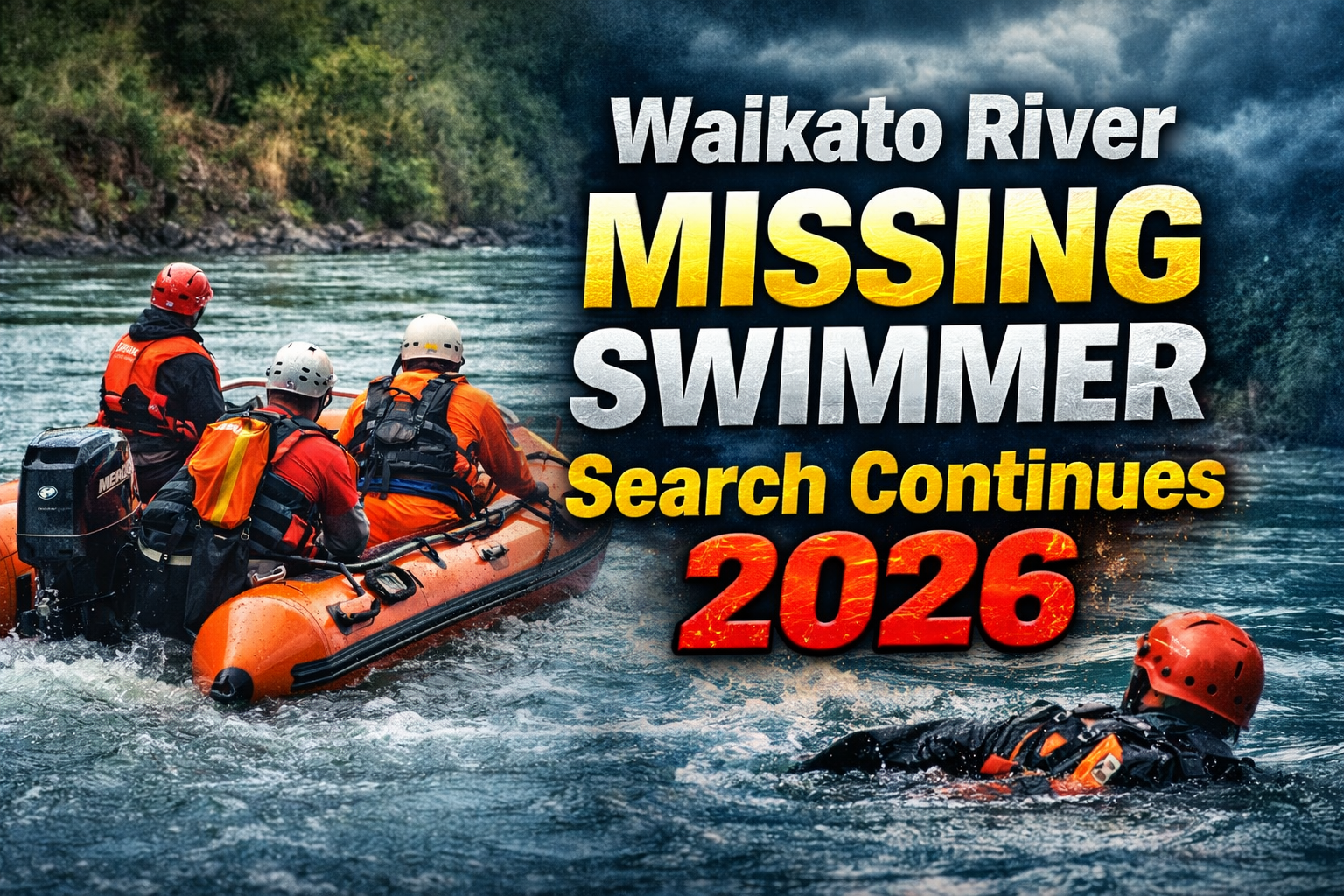
The search for a missing swimmer in the Waikato River has gripped Hamilton communities, highlighting the river’s persistent dangers despite decades of warnings. Emergency services continue their efforts amid challenging conditions, prompting fresh water safety alerts across New Zealand. This incident underscores the need for heightened awareness as summer activities peak in early 2026.
Incident Overview
The drama unfolded on a Saturday afternoon near Graham Island in Hamilton, when reports emerged of a young man struggling in the Waikato River’s swift currents. Emergency services mobilized quickly around 3:30 pm, launching boats, divers, and aerial support to comb the area. The swimmer, swept downstream rapidly, vanished from sight, triggering a multi-agency response that stretched into days.
Local police coordinated with fire services, surf life saving teams, and helicopters, scouring murky waters and riverbanks. Strong flows, debris, and poor visibility complicated efforts, turning the operation into a test of endurance for responders. Family and friends gathered nearby, their vigil a poignant backdrop to the unfolding search.
By mid-week, the operation had expanded downstream, with drones mapping potential drift paths. This event echoes similar tragedies in the river, where hidden hazards claim lives yearly, renewing calls for public caution.
Victim and Community Impact
Hamilton resident Teananga Tiotia, aged 25, was named as the missing swimmer, bringing a personal face to the story. Known locally for his vibrant spirit, Tiotia reportedly entered the water on a warm afternoon, unaware of the sudden current shifts. His family issued pleas for information, while the community rallied with social media support and roadside tributes.
The loss reverberates through Hamilton’s tight-knit neighborhoods, where the Waikato River serves as both recreational hub and solemn reminder. Schools paused for moments of reflection, and local leaders visited grieving families, offering solace amid uncertainty. Friends described Tiotia as adventurous, often enjoying outdoor pursuits, making his disappearance all the more heartbreaking.
Broader ripples affect tourism and events along the river, with organizers reviewing safety protocols. Community groups stepped up, distributing safety gear and hosting awareness talks to prevent repeats.
Search Operation Details
Rescue teams deployed a range of tactics suited to the river’s unforgiving nature. Divers plunged into cold depths, using sonar to detect anomalies, while swift-water boats navigated rapids. Helicopters with thermal imaging circled overhead, scanning for heat signatures against the water’s chill.
Police established a command center near the site, dividing the river into grid sectors for systematic coverage. Ground crews checked snags and eddies, prime entrapment spots. By day three, the search shifted to recovery mode in parts, reflecting grim realities of prolonged efforts.
Volunteers joined professionals, combing banks for clothing or items, their efforts fueled by local resolve. Weather held steady, aiding continuity, though overnight pauses tested patience. Experts noted the river’s velocity, peaking during recent rains, as a key factor prolonging the hunt.
Additional Discoveries During Search
In a startling turn, the operation uncovered a submerged vehicle containing another body, believed to be Aydan Brown, missing since August of the previous year from Chartwell. This 39-year-old had vanished under mysterious circumstances, his car now resting in the Waikato’s depths. Divers recovered the remains, referring the case to the coroner for formal identification.
The dual tragedy amplified media coverage, drawing parallels to the river’s role as unwitting preserver of past mysteries. Brown’s family, enduring months of uncertainty, received closure, though grief compounded. Police treated the incidents separately, with no links suspected.
This find prompted reviews of unsolved cases, urging better riverbed mapping to resolve lingering disappearances. It highlighted how routine searches can unearth hidden stories, reshaping narratives around the waterway.
Waikato River Hazards
The Waikato, New Zealand’s longest river, weaves through diverse terrains, from braided plains to urban stretches, harboring deceptive perils. Strong undercurrents, formed by constricted channels and inflows, pull swimmers unexpectedly. Debris like logs and branches creates strainers, trapping victims beneath surfaces.
Water quality fluctuates, with cold temperatures inducing shock even in summer. Hidden drop-offs near banks plunge depths rapidly, disorienting entrants. Recent upgrades to trails boost access, inadvertently increasing exposure for casual users.
Historical data reveals patterns: snags account for many incidents, followed by fatigue in currents. Flood events exacerbate risks, rearranging riverbeds unpredictably. Fiordland’s remoteness contrasts Hamilton’s accessibility, yet both demand respect.
| Hazard Type | Description | Common Locations |
|---|---|---|
| Strong Currents | Sudden acceleration in narrows | Near bridges, bends |
| Submerged Debris | Logs, branches trapping victims | Downstream of forests |
| Cold Water Shock | Rapid temperature drop | Shaded areas, outflows |
| Drop-offs | Steep underwater ledges | Riverbanks, islands |
| Weirs and Structures | Artificial barriers creating turbulence | Urban zones |
Water Safety Alerts Nationwide
New Zealand authorities issued urgent alerts post-incident, targeting summer hotspots. Water Safety New Zealand urged checking conditions via apps, emphasizing never swimming alone. Life jackets emerged as non-negotiables for boating or drifting.
Campaigns spotlighted “float to live,” advising victims to lie back, conserving energy until rescue. Regional councils posted signs at entry points, detailing local risks. Schools integrated sessions, teaching reach-rescue techniques over entering water.
Surf Life Saving expanded patrols, linking river education to coastal efforts. Social media blasts reached youth, using relatable scenarios. Stats from prior years show alerts reduce incidents by highlighting peak danger times like afternoons.
Historical Context of River Incidents
The Waikato claims numerous lives annually, with peaks during holidays. Past cases mirror this: groups splintered by currents, solo adventurers misjudging flows. A cluster in recent summers prompted infrastructure like boom nets at weirs.
Conservation efforts cleaned debris, yet natural regeneration refills hazards. Community dives recovered past victims, informing prevention. National reports track trends, noting urban proximity heightens casual entries.
Lessons from events shaped policies, mandating life ring installations. Indigenous perspectives, viewing the river as taonga, enrich holistic approaches, blending modern tech with traditional lore.
Role of Emergency Services
New Zealand’s response framework shines in crises, uniting police, fire, and ambulance under unified command. Dive squads train rigorously for low-visibility ops, using side-scan sonar advances. Helicopters from multiple bases ensure rapid deployment.
Voluntary groups like Coastguard bolster resources, their boats slicing through swells. Training simulations replicate Waikato scenarios, honing teamwork. Post-operation debriefs refine tactics, incorporating drone feeds for real-time intel.
Public tips prove invaluable, with hotlines fielding sightings. Inter-agency briefings keep efforts synchronized, minimizing overlap.
Community and Government Responses
Hamilton Mayor rallied support, pledging funds for safety upgrades. Iwi leaders invoked karakia at searches, honoring the river’s mana. Fundraisers aided families, channeling grief into action.
Government eyed river management reviews, proposing barriers at hotspots. MPs advocated national water safety funding, tying to tourism recovery. Schools hosted forums, empowering youth as advocates.
Prevention Strategies and Education
Experts recommend pre-swim checks: observe currents, test depths. Buddy systems save lives, with spotters onshore. Gear like whistles aids signaling.
Apps deliver live data, from flows to rescue proximities. Programs target migrants, bridging cultural gaps in awareness. Long-term, engineered channels could tame sections, balancing ecology.
Lessons Learned and Future Outlook
This search reinforces vigilance, transforming tragedy into teachable moments. Enhanced monitoring via sensors promises early warnings. Collaborative guardianship, involving locals, sustains momentum.
As 2026 unfolds, renewed commitments fortify defenses against the river’s whims. Communities emerge resilient, honoring lost lives through proactive stewardship. The Waikato endures, its lessons etching deeper into collective memory.

Vineeth T.C. is a news writer and digital content contributor at PageEuropean, covering key developments across New Zealand and Australia. His work focuses on delivering clear, fact-based reporting on current affairs, public policy, business updates, and regional news that matter to readers.