
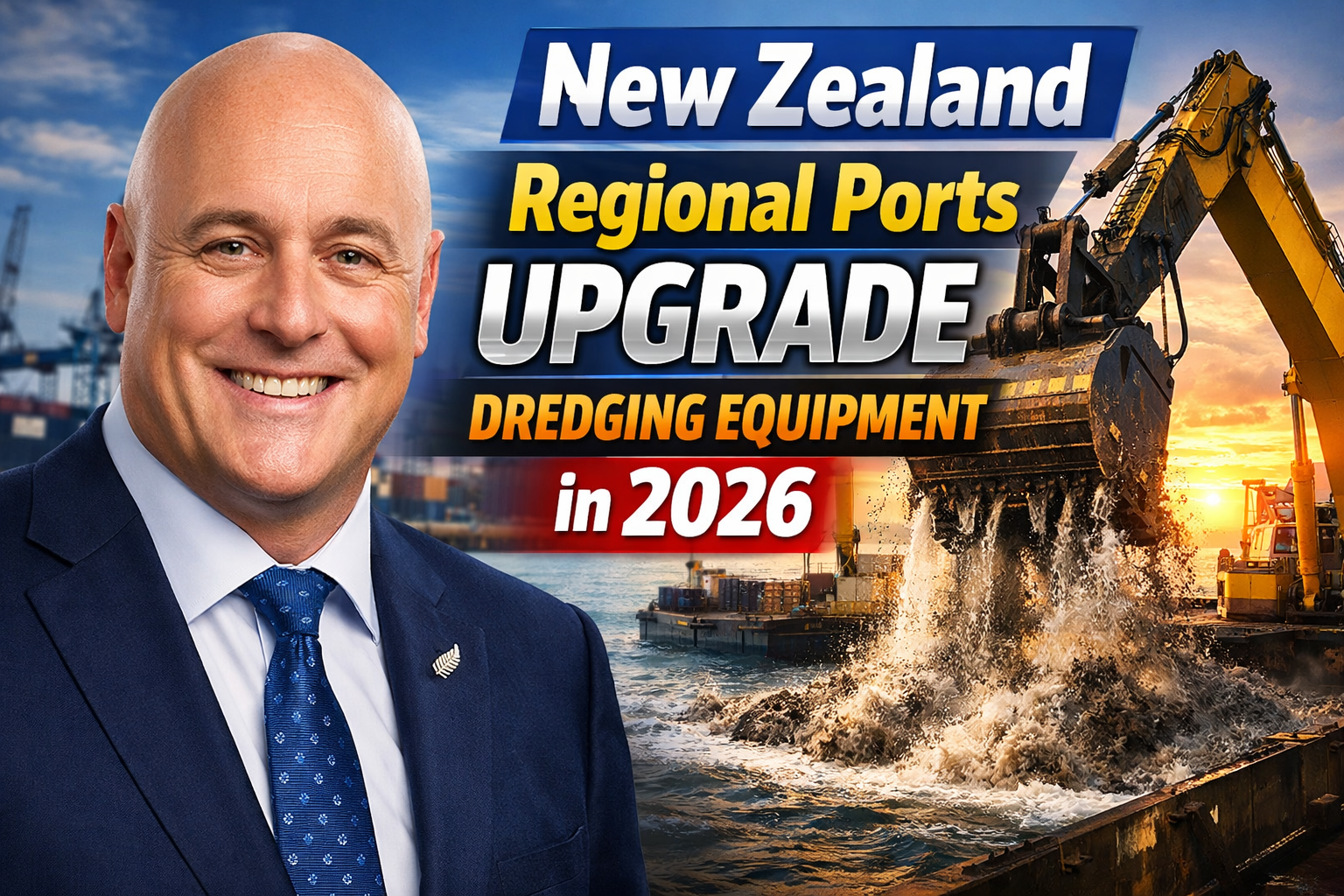
New Zealand’s regional ports are undergoing transformative upgrades in 2026 with advanced dredging equipment investments, enhancing access for larger vessels and bolstering supply chain resilience. These initiatives address sediment buildup challenges, ensuring reliable trade routes amid climate pressures and economic growth demands.
Introduction
Regional ports beyond Auckland and Tauranga play crucial roles in sustaining New Zealand’s export-driven economy, handling logs, dairy, and regional cargo vital to rural communities. In 2026, government-backed projects introduce purpose-built dredging barges and hopper dredgers, targeting sediment-prone harbors like Greymouth, Whanganui, and Ōpōtiki. Cyclone Gabrielle’s 2023 lessons exposed vulnerabilities, where silted channels blocked emergency supplies, prompting eight million dollar infusions via the Coastal Shipping Resilience Fund.
Public-private partnerships accelerate this shift, with vessels entering service by late 2027 to maintain depths for feeder ships. Napier and Port Otago’s joint thirty-six million dollar dredge exemplifies scale, optimizing consents up to fourteen point five meters. These upgrades promise faster recovery, lower costs, and greener operations, fortifying maritime infrastructure nationwide.
Government-Led Dredging Barge Initiative
The cornerstone of 2026 upgrades is an eight million dollar government investment in a crane dredging hopper barge, co-funded with Johnson Bros Limited to twelve point nine million total. Designed for small-to-medium ports, this mobile asset removes entrance sediments swiftly, restoring navigable depths during disasters when roads fail.
Ports like Greymouth—prone to West Coast silt—previously denied ships critical fuel and food post-floods. The barge’s nationwide deployability ensures rapid response, operating in shallow coasts unsuitable for mega-dredgers. Construction starts mid-2026, prioritizing low-emission engines and precision monitoring for minimal environmental impact.
Transport Minister James Meager emphasizes resilience: coastal shipping becomes lifelines when inland networks collapse. This vessel fills a decade-long gap, making dredging commercially viable for under-resourced ports and cutting emergency delays from weeks to days.
Napier Port and Port Otago Joint Venture
Napier Port and Port Otago forge ahead with a landmark thirty-six million dollar trailing suction hopper dredge from Damen Shipyards, forming a dedicated dredging company. Port Otago operates the TSHD-1000, replacing its forty-year-old New Era with tech slashing carbon footprints and enhancing efficiency.
Napier targets channel deepening from twelve point five to fourteen point five meters low water, maximizing consents to 2053 without new applications. This accommodates larger bulk carriers, boosting log exports through Hawke’s Bay. Port Otago deepens its lower harbor to fifteen meters alongside new tugs and wharves by January 2026.
Sustainability drives design: advanced dredging systems recycle spoil onshore, reducing marine discharge. Shared ownership avoids duplication, serving both ports while offering services regionally.
| Port | Dredge Investment | Depth Gain | Timeline |
|---|---|---|---|
| Napier-Port Otago JV | $36m TSHD-1000 | 12.5m to 14.5m | 2026 delivery |
| Government Barge | $8m crane hopper | Variable harbor entrances | Late 2027 service |
| Port Taranaki | Consent renewal | Maintenance dredging | Mid-2026 |
Port Taranaki’s Consent Renewal Push
Port Taranaki advances maintenance dredging consents with Taranaki Regional Council, lodging mid-2025 for 2026 implementation. This sustains oil, gas, and fertilizer channels against coastal erosion, ensuring safe berthing for tankers and bulkers.
Upgrades incorporate real-time sediment modeling, optimizing spoil disposal to beaches or reclamation sites. Enhanced equipment minimizes turbidity plumes, aligning with stricter iwi and environmental protocols.
Lyttelton and Other Major Updates
Lyttelton Port Company rolls out a dredging surcharge from January 2026, funding ongoing maintenance amid rising vessel sizes. This supports container growth, with channels holding fourteen meters despite seismic risks.
Port of Auckland progresses FY26 channel deepening, though regional focus shifts burdens. Smaller ports like Whanganui gain from the national barge, reversing post-Gabrielle access losses.
Technological Advancements in Dredging Gear
Modern dredgers integrate GPS-guided cutters, automated load sensors, and AI plume predictors. Damen’s TSHD boasts dynamic positioning, holding steady in swells without anchors. Hopper capacities handle thousands of cubic meters per pass, discharging via rainbow or bottom dumping precisely.
Eco-features include biodegradable flocculants for spoil settling and electric auxiliaries cutting fuel thirty percent. Drones survey pre- and post-dredge bathymetry, feeding digital twins for predictive maintenance.
Economic Impacts on Trade and Regional Growth
Upgrades unlock billions in trade: deeper channels admit Panamax-class ships, trimming transshipment via Australia. Regional economies thrive—Northland timber, Taranaki energy, South Island logs flow freer.
Post-disaster logistics accelerate: cyclone-hit areas receive aid within days, stabilizing prices. Freight costs drop five to ten percent long-term, aiding exporters against global rivals.
Job creation spans construction, operation, and spin-offs—marine engineers, skippers, and analysts. Rural ports gain year-round viability, diversifying from seasonal cargo.
| Benefit Category | Projected Gains |
|---|---|
| Trade Volume | +15-20% regional cargo |
| Cost Savings | 10% lower dredging contracts |
| Disaster Response | Halves supply delays |
| Employment | 200+ direct roles nationwide |
Environmental and Community Considerations
Sustainability tempers expansion: consents mandate water quality monitoring, protecting kaimoana beds. Beneficial reuse turns spoil into beach nourishment or port land, as at Napier.
Iwi partnerships ensure co-design—Ngāti Porou consults Ōpōtiki upgrades. Noise, light, and vessel traffic mitigations safeguard marine mammals.
Communities benefit from resilient supply: fuel depots restock faster, grocers avoid shortages. Public wharves stay open, supporting tourism ferries.
Challenges and Mitigation Strategies
Budget overruns loom—Damen builds face steel hikes—but fixed-price contracts shield risks. Regulatory delays plague consents; pre-lodged applications preempt this.
Extreme weather tests new gear: cyclone-season trials validate robustness. Skilled crews require training academies, with Damen providing simulators.
Government Policy and Funding Framework
The Coastal Shipping Resilience Fund channels funds strategically, prioritizing multi-port assets. National Infrastructure Plan 2025 embeds dredging in transport basics, alongside road-rail hardening.
Private investment incentives—tax credits, low-interest loans—spur JVs. Commerce Commission oversees surcharges for fairness.
Future Outlook for NZ Maritime Infrastructure
By 2030, regional ports rival majors in efficiency, handling forty percent more volume. Electrified dredgers and autonomous surveys emerge, with hydrogen pilots by decade-end.
Integration with rail-ports hybrids optimizes modals, while blue economy ventures—offshore wind farms—demand sustained depths. These upgrades cement New Zealand’s trade gateway status, weatherproofed for a volatile Pacific.
Case Studies: Success from Early Adopters
Napier’s phased dredging post-2018 consultation deepened channels incrementally, lifting crane capacities without disruption. Port Otago’s expertise ensures seamless TSHD rollout.
The government’s barge prototypes Australian models, adapting for Kiwi coasts. Whanganui trials post-2026 promise model replication.
Call to Sustained Investment
2026 dredging leaps position regions as resilient hubs, blending innovation with necessity. Continued funding, tech adoption, and stakeholder unity will sustain gains, powering exports and communities through storms ahead.

Vineeth T.C. is a news writer and digital content contributor at PageEuropean, covering key developments across New Zealand and Australia. His work focuses on delivering clear, fact-based reporting on current affairs, public policy, business updates, and regional news that matter to readers.