
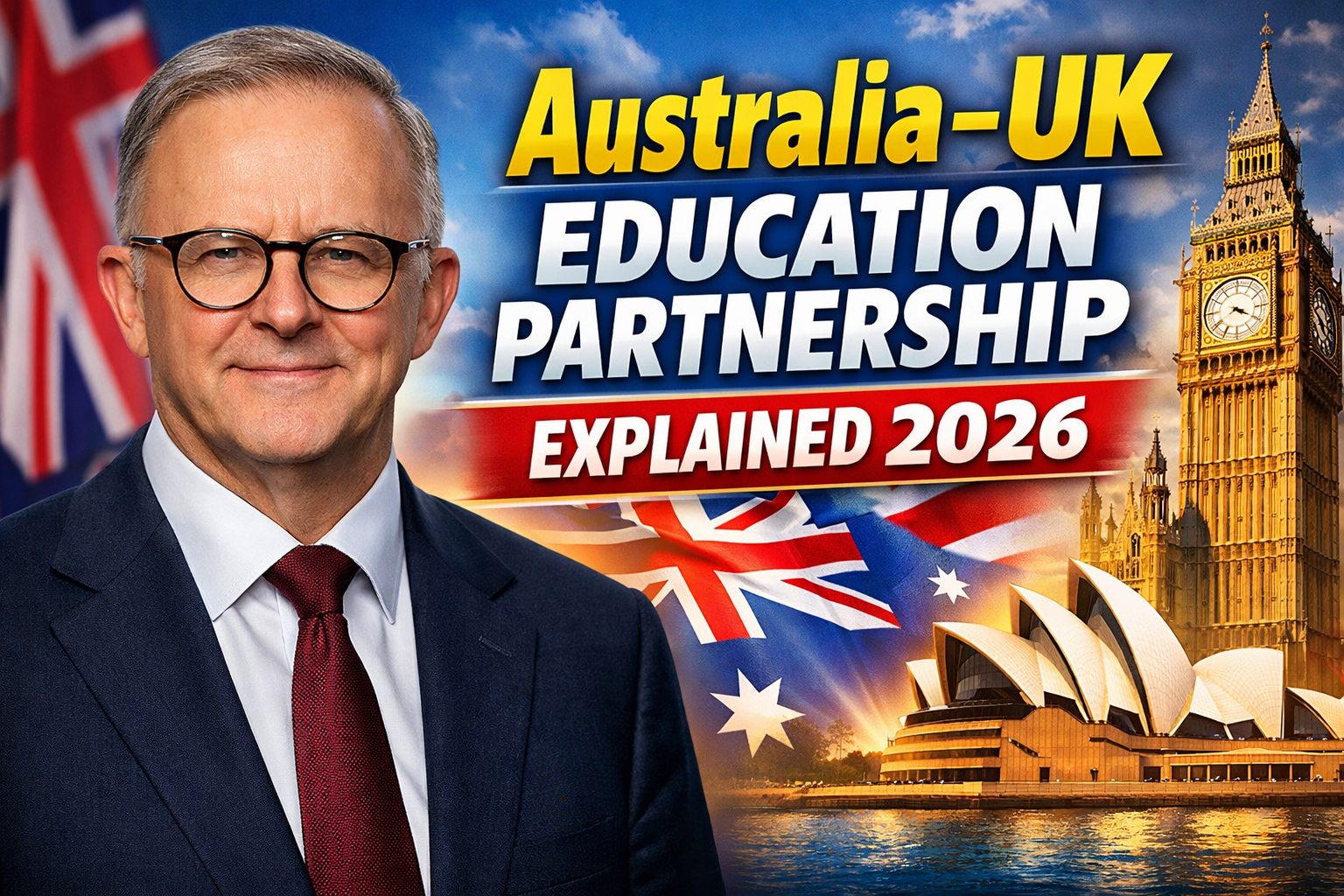
The Australia-UK education partnership thrives in 2026, bolstered by strategic alliances like the Advanced Skills Alliance and renewed dialogues fostering student mobility and joint research. This collaboration opens doors for scholarships, exchanges, and enhanced career prospects across both nations. Students benefit from seamless opportunities in fields like defense, technology, and innovation.
Partnership Background
The partnership builds on longstanding ties, amplified by the UK-Australia Geelong Treaty and AUKUS commitments. In late 2025, education ministers from both countries signed key agreements at UNSW Sydney, launching the Advanced Skills Alliance involving top universities. This initiative unites Australian institutions like UNSW, Curtin, and Adelaide with UK powerhouses such as Imperial College London, King’s College London, Cranfield University, University of Southampton, and University of Strathclyde.
Ministers re-established the Australia-UK Education Dialogue for annual policy exchanges on early childhood, school innovation, and tertiary pathways. Focus areas include flexible modular education aligned with workforce needs, particularly in security and resilience. The pact emphasizes joint doctoral training, short courses, and micro-credentials to support bilateral goals.
These developments follow the Australia-UK Free Trade Agreement, promoting research in AI, quantum technologies, and cyber capabilities. Over 100,000 students annually engage in cross-mobility, with numbers projected to rise through expanded reciprocal schemes.
Key Initiatives and Agreements
Central to 2026 efforts is the Advanced Skills Alliance, creating a joint UK-Australia Centre for Doctoral Training. PhD candidates in nuclear engineering, systems design, and cybersecurity spend up to 12 months in the partner country, building expertise and networks. Expansion plans include TAFEs and colleges for broader workforce training.
The Geelong Treaty reinforces education as a pillar for innovation, with AUKED meetings addressing inclusive early education and vocational alignment. Universities commit to protecting sensitive research while sharing infrastructure and data.
Additional frameworks like the Northcote Postgraduate Scholarship enable UK students for Australian higher degrees, fostering bidirectional flow. These initiatives drive economic resilience, with joint projects expected to generate thousands of skilled jobs.
Scholarships Overview
Scholarships form the backbone, offering financial support for tuition, living costs, and travel. Australian Government programs like Australia Awards Scholarships provide full funding for postgraduate studies, targeting developing regions but open to UK applicants in priority fields. Destination Australia Scholarships award up to 15,000 dollars annually for regional study, encouraging underrepresented areas.
UK-side, the Northcote scheme funds three-year higher degrees at Australian universities. University-specific options abound: Deakin Vice-Chancellor’s offers substantial tuition reductions, while University of Adelaide provides up to 50,000 dollars for high achievers. In 2026, AUKUS-aligned scholarships prioritize STEM, with values reaching 34,000 dollars per annum plus health cover.
Application windows open mid-2025 for 2026 intakes, requiring strong academics, leadership, and alignment with partnership goals. Over 5,000 awards distributed yearly, with success rates around 20 percent for competitive pools.
| Scholarship Name | Provider | Value (Annual) | Eligibility Focus | Duration |
|---|---|---|---|---|
| Australia Awards | Australian Government | Full tuition + living | Postgraduate, leadership | Up to 4 years |
| Destination Australia | Australian Government | 15,000 dollars | Regional study | Up to 4 years |
| Northcote Postgraduate | Joint AU-UK | Full funding | UK students in AU PhD | 3 years |
| Deakin Vice-Chancellor’s | Deakin University | 20-50% tuition | High GPA internationals | Program length |
| Adelaide International | University of Adelaide | Up to 50,000 dollars total | Research degrees | Varies |
Exchange Programs
Student exchanges thrive under reciprocal agreements, allowing seamless credit transfer without extra fees. Universities like UNSW and Curtin host UK students for semesters or years, with deadlines for 2026 Semester 1 closing late 2025. Programs span academic year, semester, or three-month immersions, emphasizing cultural adaptation.
Eligibility demands credit average (65 percent plus), with partner universities setting higher bars. Participants remain enrolled home-side, paying domestic fees. Key dates: Nominations by October 2025 for mid-2026 starts.
Benefits include diverse course options, from business at Southampton to engineering at Imperial. Over 2,000 exchanges annually, with expansions via Alliance universities. Visa processes streamline under partnership visas.
| Program Length | Typical Dates (2026) | Application Deadline | Fee Structure (Home Uni) |
|---|---|---|---|
| Semester | Feb-Jun or Jul-Oct | Oct 2025/Feb 2026 | No host fees |
| Academic Year | Feb-Dec | Jul 2025 | Tuition to home uni |
| Short-Term (3 mo) | Jan-Mar or Aug-Dec | Varies | Program fees apply |
Participating Universities
Alliance members lead: Australia’s UNSW excels in innovation hubs, Curtin in resources engineering, Adelaide in defense research. UK counterparts shine—Imperial in quantum, King’s in health security, Cranfield in aerospace, Southampton in maritime, Strathclyde in naval systems.
Broader networks include Russell Group and Regional Universities Network ties. Students access 50-plus partners, with credit mapping via myPlan tools. Expansions target all eligible institutions by mid-2026.
Career Benefits
Partnership yields tangible career edges. Graduates gain dual-market credentials, prized in AUKUS sectors. Joint PhDs lead to roles in nuclear submarine programs, cyber firms, and quantum startups, with starting salaries averaging 80,000 dollars.
Networks span defense contractors like BAE Systems and Australian firms. Micro-credentials boost resumes for agile workforces. Alumni report 30 percent faster promotions, global mobility via reciprocal visas.
Employers value cross-cultural skills; 85 percent of participants secure jobs within six months. Fields like AI see demand surge, with partnerships ensuring alignment.
| Benefit Category | Impact Statistic | Example Fields |
|---|---|---|
| Employment Speed | 85% placed in 6 months | Defense, Tech |
| Salary Premium | 20% above average | Engineering, Cyber |
| Mobility Options | Reciprocal visas | Research, Industry |
| Promotion Rate | 30% faster | Innovation sectors |
How to Apply
Start with university exchange offices or scholarship portals. Assess eligibility via GPA calculators. Submit transcripts, statements, and references by deadlines—early bird advantages apply.
Leverage advisors for partner matching. Visa prep involves proof of funds, health cover. Post-acceptance, orientation covers housing and credits.
Success tips: Highlight partnership alignment, secure referees from relevant fields.
Future Outlook
By late 2026, expect AUKED expansions, more scholarships, and TAFE integrations. Doctoral intakes double, fueling AUKUS delivery. This partnership positions both nations as education leaders, benefiting thousands.

Vineeth T.C. is a news writer and digital content contributor at PageEuropean, covering key developments across New Zealand and Australia. His work focuses on delivering clear, fact-based reporting on current affairs, public policy, business updates, and regional news that matter to readers.